
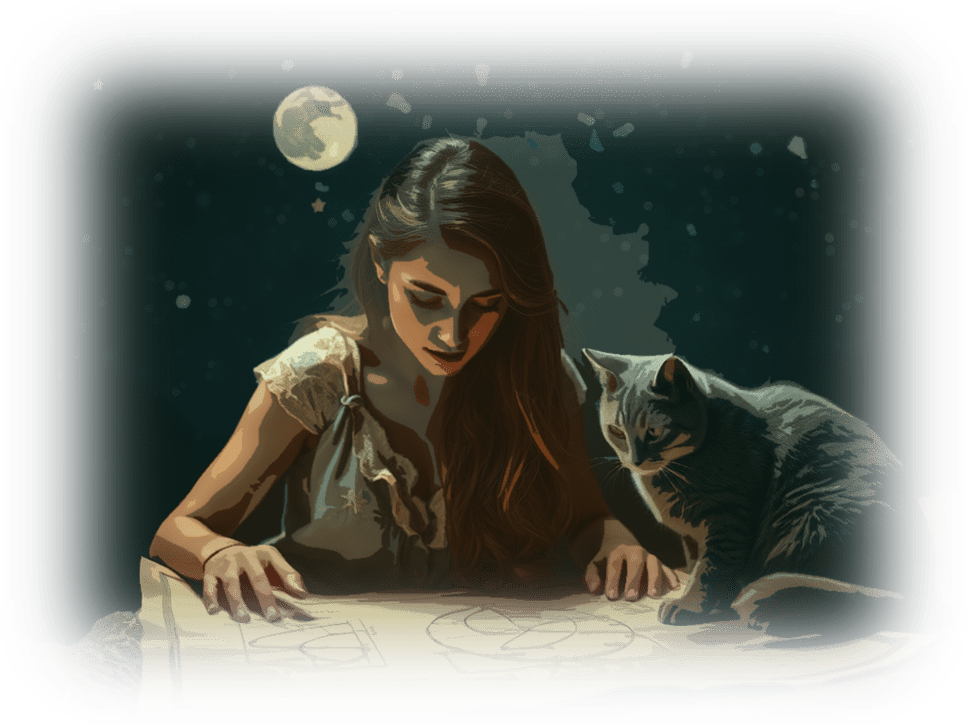
Long ago, before textbooks and telescopes, there lived a village tucked beneath a sky so full of stars that it seemed the heavens were a bowl spilled with salt. The people of the village believed the stars were holes poked in the sky by a giant cat, so that divine light could shine through from the other side.
The cat’s name, they said, was Moggie the Eternal, and every time a star appeared, it was because Moggie had sharpened her claws in the sky. “Poke,” they’d say. “A new star is born.”
Children smiled at this. Elders nodded. And no one questioned it… except for a girl named Lin.
Lin loved the stars, but she also loved questions. She asked why some stars twinkled and others didn’t. Why they moved with the seasons. Why some suddenly disappeared.
“Moggie is mysterious,” the villagers would say.
But Lin wasn’t satisfied with mystery for mystery’s sake. So, she began to study. She watched the skies, drew charts, and learned from travelers who passed through with stories of far-off observatories. She built a lens from river glass and bronze scraps. She charted constellations on goat hide. She learned the stars were not holes in the sky, but distant suns, each burning in the cold darkness of space.
At her side was a small cat of her own. He had soft gray fur and a determined little face. His name was Kobiyashi[1] Maru or “Maru” for short. Whenever Lin grew frustrated with the villagers’ resistance, Maru would walk straight into the walls of her workshop.
Thump.
Sometimes once. Sometimes over and over.
It started as clumsiness. But in time, Lin realized it was empathy. A cat trying to understand the invisible barriers she faced. A cat who walked into walls because he knew she did, too.
When Lin shared what she learned, the village scoffed.
“That’s too complicated,” said the baker. “Stars can’t be suns. They’re too small.”
“I don’t get any of that,” said the priest. “You can’t even see all that stuff without a magic tube. If I don’t understand it, it must not be true. God did it. End of story.”
Lin kept going. Because Maru kept walking.
One night, an old woman approached her, gazing at her maps and lenses.
“I remember when I thought Empurress Moggie poked holes in the sky to make the stars,” she said. “But now I see that truth doesn’t need to be simple to be beautiful. Understanding can be a form of worship too.”
Together, they watched the night sky.
Not as a mystery to be feared.
But as a puzzle waiting to be explored.
Reflection
In Luminism, the pursuit of knowledge is sacred. Mystery is not our enemy, but neither is it an excuse to stop asking questions. When we meet a gap in understanding, we must not fill it with gods out of habit or fear. We must fill it with curiosity, evidence, and wonder.
To say, “I don’t know,” is honest.
To say, “I don’t understand, so it must be magic,” is surrender.
There is no shame in not knowing. But there is danger in pretending that ignorance is the end of inquiry.
And if you ever find yourself walking into walls out of frustration, exhaustion, and for being misunderstood, know that even in those moments, you are not alone.
Maru walks with you.
Lin walks with you.
And so do all who choose to question.
Let your questions be the lens through which light grows sharper. And never be afraid to ask why.
[1] Kobiyashi Maru – “Kobiyashi” is misspelled on purpose.


Leave a Reply