
Luminism is a modern philosophy and religion of reason, compassion, and moral clarity. It teaches that goodness stands on its own… not on dogma, not on fear, and never on threat of divine punishment.
There once was a man of perfect stature named David. He had a great job and, through financial discipline, he amassed great wealth. He used his wealth to start or purchase many businesses. He owned several homes across the country and around the world. He had a pleasant, yet nymphomaniacal, wife who bore him 111 children.
Because he was so hardworking and his body and mind were too exhausted, he could not volunteer in the community. Instead, he regularly gave to the needy. However, he did not often donate to organizations as that can make them entitled and lead to corruption. David taught his children that it was right to give of their time and, when they become adults, financial wealth. He regularly sent his children out to volunteer in the community, and as if by a miracle, they all obeyed without any of the typical adolescent rebelliousness.
His one selfish pleasure was his hobby of collecting rare cars. On his 42nd birthday, David purchased his 111th car. To celebrate, he organized a grand parade to share his love of rare cars with the community. All the drivers would be his children.
During the parade, to the horror of everyone present, each and every single one of his cars exploded!
After the mass-funeral of all his children, the police investigators reported they could not find any evidence of foul play. There was no reason whatsoever for the cars to explode!
A week after the police provided their report, the financial news station reported that all of his businesses were going bankrupt. To make matters worse, hackers stole millions of dollars out of his bank accounts.
David was almost penniless, so he decided that he could sell some of his properties to help rebuild his life. Unfortunately, his homes across the country were burned to the ground during riots started by former employees who lost their jobs when his companies went bankrupt.
All of his homes in different countries suffered similar fates. An African prince nationalized his villa and turned it into a palace. His Chinese home was seized by the government. His home in Venice fell into the sea. Even his research compound in Antarctica, which was also his favorite vacation spot, was destroyed by the first ever tornado to occur on the continent in all of human history!
He walked toward his primary and final home when it suddenly exploded!
Penniless and now homeless, David and his wife sat looking at the rubble of their home. His wife then turned to him and handed him divorce papers. She said that with everything that has been going on, David hasn’t been satisfying her and she was leaving him for someone who could.
As he signed the papers, his wife mentioned that she’s noticing a bunch of Poxes that are cropping up all over her body, and he should probably get checked out.
The pox hurt his body so David wallowed in his great misfortune for several days before getting checking into a hospital. As he lay in the isolation ward of the hospital, he cursed every God and Goddess he could think of.
All his friends sided with his wife and those he knew independently turned out to merely be “fair-weather friends” and wouldn’t return his calls. Not even the hospital staff would speak with him outside the bare-minimum required to do their daily tasks. David supposed that was okay because his voice was too sore from all the cursing.
His one visitor at the hospital was a termite that would use his tray table to crawl past his bed at the same time every morning, and again at night. Desperate for companionship, and a bit bitter at having no friends, he called the next time it passed, “Hey, Wanker! Why do you pass my bed every day?”
The termite stopped and seemed to study him for a moment before continuing to crawl along its way.
“Wanker, I was talking to you!”
Again, the bug stopped, but this time it shocked David by saying, “Dear sir, my name is not, Wanker, as you called me. I am called Azazel. I apologize for not responding earlier, but you have been using all manner of foul language these past few light-cycles I figured you were speaking to one of the ghosts who attend you.”
David had never heard a termite speak, so it took a few moments for him to collect himself. During the pause, the termite continued crawling. Worried at losing this opportunity for conversation, David quickly apologized, “I’m sorry. I’ve been suffering so much lately. Could you find it in your heart to stay and speak with me for a while?”
The termite paused and responded, “It is getting late, and I must return home before the warriors seal the colony for the night. I will return tomorrow morning and hear what you have to say.”
With that, the termite quickly scurried away.
David eagerly waited for Azazel to return the next morning. As the termite began crawling along his bed, David smiled for the first time in several weeks.
The termite stopped and said, “Speak, large one.”
David introduced himself. He described his life, his wonderful children, and his great fortune. He then lamented the series of misfortunes to befall him. He described at great length how each unfortunate event happened for no reason at all. He worked himself into a rage and cursed all the Gods and Goddesses he would think of.
When David calmed himself, he noticed that Azazel started to crawl away. The termite stopped only to say, “Get a Job!”
That was the last time David saw Azazel, and it was probably a good thing because he had half the mind to squash the impertinent bug. His rage at being abandoned subsided, and the pox which covered his body did soon after.
As he recovered from the sickness, he realized that getting a job was the best thing for him to do. It would get his mind off his troubles and he could restart his life anew. Yes! He will learn from his mistakes this time and surround himself with people who truly cared for him, for who he is and not what he can do for others.
David was eventually released from the hospital. He had nothing but his name, yet he managed to find a sympathetic business owner who offered him a job at a coffee shop.
David was grateful and worked hard for the business owner. After three weeks of working at the café, David’s former personal assistant showed up to his new job.
His assistant apologized for not arriving sooner, but apparently, David contaminated his office with the pox and his assistant was in the same hospital he was. While recovering, the assistant filed insurance claims on all David’s homes. While some of the homes were lost for reasons outside the coverage plans, the insurance companies are paying out the claims to the sum of 6-million dollars.
While being discharged from the hospital, the assistant asked everyone he could where his former boss went. Noone knew, and some said they were glad to have the miserable man out of their hospital. One nurse mentioned she saw David at a café and gave the assistant the location. When the assistant left the hospital, he went directly to the P.O. box and came here with the first couple checks!
David was so happy with his former assistant, so happy at his turn of luck, he kissed the assistant. He immediately gave his 2-weeks’ notice to his employer and promised to rehire his assistant.
As David was rebuilding his life, his ex-wife tried to rekindle their relationship. David was not interested. In a rare display of spite, he told his wife that he too found love and was glad she left him because now he can be with the man he loves.
David’s ex-wife was so ashamed at being replaced by a man, she ran away and fled the country.
David was so shocked by his spitefulness, he apologized to his assistant for the lie he told. The assistant forgave him immediately.
David took notice of his assistant more and more, and they did eventually start a relationship. They even started a family by adopting many, many children. David and his family had a very prosperous life, and they continued to contribute to the community they lived in for the rest of their natural lives.
***
It is amazing how life can be upended by seemingly supernatural causes and lead a man to become spiteful and curse every God and Goddess that may not even have existed. Yet, a termite… a creature that is often seen as destructive, is the source of wisdom that nudges David to start anew.
Saul was a religious zealot, employed by the government as an informant to persecute people of other faiths. His relentless devotion to rooting out religious minorities knew no bounds. He consistently tormented them with malicious intent, raiding homes and dragging entire families to prison. Saul was also a regular attendee at executions, especially stonings, though he never participated directly due to his weak throwing arm. Despite never physically killing anyone, Saul’s actions condemned countless individuals to death, and his hands were forever stained with the blood of his victims.
One day, Saul prepared for a journey to arrest a group of religious pilgrims in a distant city. Fueled by excitement, he barely noticed a house fire as he passed. When he did, he realized the home’s owner displayed symbols of a minority faith. Seizing the opportunity, he approached to make his first arrest of the day.
Unbeknownst to Saul, the homeowner was an alchemist. Chemicals from the burning house released toxic fumes, which wafted into Saul’s face. At first, he was unfazed, but the smoke soon overwhelmed him. Gasping for air, he collapsed, clutching his burning eyes.
The man he had intended to arrest rushed to his aid, pulling him away from the smoke and guiding him to fresh air. Temporarily blinded, Saul relied on his would-be prisoner to lead him to a healer in a nearby city.
The healer, a member of the same faith Saul persecuted, treated him with kindness, rinsing his eyes with saline and feeding him anti-inflammatory herbs. As part of his ritual, the healer also prayed over Saul.
As the herbs took effect, Saul drifted into a deep sleep and dreamed vividly. In his dream, he saw the faces of those he condemned, heard their cries for mercy, and felt the weight of their suffering. A man’s voice echoed through the dream: “Saul, why do you persecute us?” Though he never seen the man before, Saul instinctively knew it was the healer treating him.
The next morning, Saul awoke and removed the bandages from his eyes. His vision was restored and his first sight was… a chamber pot. Once relieved, his second sight was the healer, who looked exactly like the man in his dream.
Overwhelmed with gratitude and guilt, Saul confessed his evil deeds to the healer. He spoke of his past deeds, his hatred, and the harm he caused. Moved by Saul’s contrition, the healer explained how he may seek redemption. To make amends on this world he must renounce his old ways, embrace the faith he once sought to destroy, and accept the sacrifice of a divine figure who absolved humanity’s fall from grace.
Saul underwent a baptism to cleanse himself of his past. To complete his reinvention, Saul changed his name to Paul, which served as a cloak for his prior evil deeds.
As Paul, he traveled the world, spreading the faith he once tried to erase. He became a prolific preacher and writer, penning letters that shaped the doctrines of his new religion. However, his new life was not without hardship. Everywhere he went, Paul faced opposition. He was beaten, imprisoned, and threatened with death.
Despite his new name and identity, a former associate, recognizing him and turned him in to authorities. Paul demanded his case be heard by the Cesarean Section Council and he was taken to the regional capital. The council was led by a follower of Ipusa, a god who despised traitors and shapeshifters.
Paul was harshly judged for betraying his original faith and was sentenced to public disintegration. His execution aired on primetime news, where he dissolved into light to the sound of roaring applause.
In the afterlife, Paul faced judgment. A voice echoed through the void, recounting his deeds. Though he had tried to redeem himself, the weight of his early atrocities overshadowed his later good works.
The narrator’s stern voice boomed through the void to pronounce a final judgement upon his soul. “Despite shedding your name and claiming redemption, your deeds, and the intent behind them, cannot be washed away. For your consistent harm to others with malicious intent, your soul will be deleted. You are undeserving of existence.”
And so, Paul was erased.
Despite his grim end, Paul’s teachings endured and helped shape his faith into a dominant religion. Ironically, he became one of its most celebrated figures, his legacy living on long after his soul’s deletion.
About fifty years after departing to spread the Nine Please Principles throughout the known universe, Angelica returned to see what had grown from the seed she had planted on this world.
She was traveling with her adolescent son, who was recently conceived with a lover… though “recent” is relative when one lives for seven thousand years. On this voyage, she intended to teach him how choices ripple outward through time. She explained how her ship had once crashed here, and how a primitive local man had helped her crew to safety. In return, she had freed his people from slavery.
Her son asked if those people had deified her. Angelica shook her head.
“No. The man I helped knew my work was done with technology. He already had a religion, and he used it to cement his authority over the freed slaves.”
She paused, watching Earth grow larger in the viewscreen, recalling that night on Mt. Cyanide. “I was concerned about the direction he wanted to take his people. I wanted no part in aiding him in a genocidal holy war.”
Her son gave a knowing look. “This will be interesting.”
When they entered Earth space, a patrol ship scanned them for contraband and logged their purpose with local authorities. Angelica declared their visit an educational expedition to study how primitive cultures develop and how moderate interference shapes them over time.
Cleared to proceed, they descended toward the “Promised Land” her former friend had once spoken of. While cloaked, her ship scanned villages and towns for genetic markers linked to the former slaves. They were scattered, but she chose a landing site near the Egyptian Empire.
Disguised as nomads, she and her son interviewed villagers along the border. They heard troubling tales of a nomadic nation that had passed through a decade earlier. Many city-states had allowed them passage, while others had resisted and had been utterly annihilated, every man, woman, and child killed.
As they traveled, the pattern became clear. The former slaves had destroyed and pillaged their way toward their promised land, eradicating seven nations in the name of their god.
Angelica saw the worry on her son’s face and felt shame. Her well-intentioned good deed had contributed to this devastation. “We must learn more about what happened,” she told him, “and fix it.”
***
Days later, they found her former friend preparing to cross a river for another invasion. Though older, he had not aged as much as most of his people, some of whom likely died of old age. Beside him stood a man who, from a distance, looked like a Federation citizen.
That would explain the slowed aging, Angelica thought to herself.
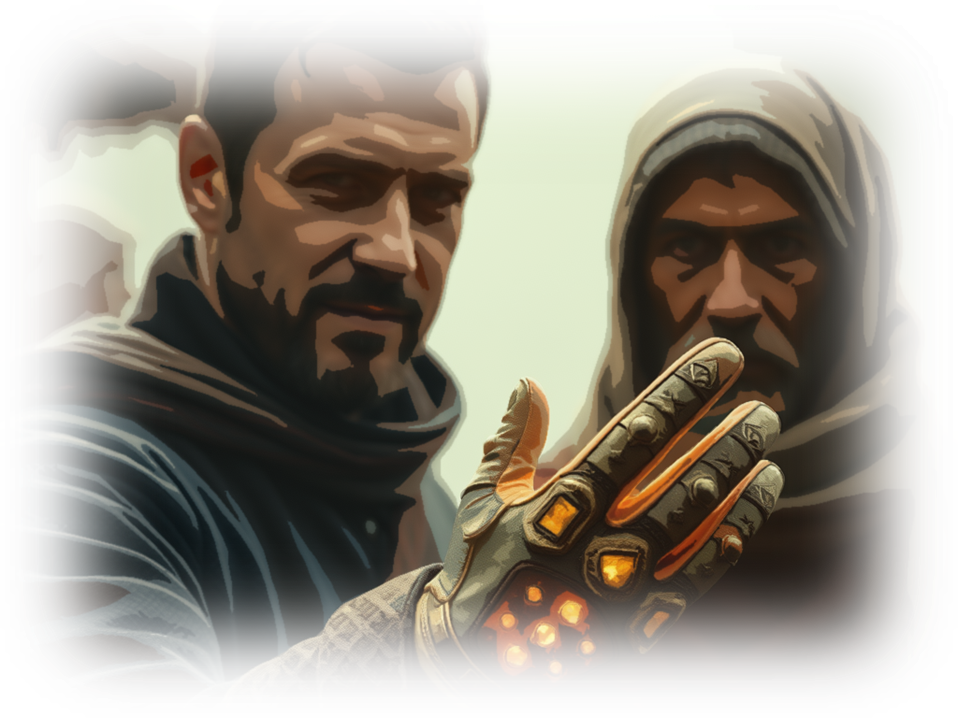
The stranger’s gaze reached Angelica, and his eyes widened at the sight of Angelica, then narrowed in recognition of a fellow Federal citizen. His hands began to move in strange, pointed gestures. Her son noticed and whispered, “He must have one of those new command computers with a single-sided holographic display. Clever!”
“Quite clever indeed,” Angelica replied. “To these primitives, it looks like he’s casting a spell. But I’m sure he’s running a records search to find out who we are and where we’ve been.”
“So, he knows what you did?”
“He will by the time he greets us,” she said. “Be prepared for anything… even my arrest.”
“What? Arrest?!” Her son asked, with concern.
“Shh!” She nodded toward the now-approaching man. “I’m sure he’ll explain everything. A man like him probably enjoys hearing himself talk while he gloats.”
The newcomer introduced himself as a Federation scientist studying the indigenous population to observe their reactions to exotic materials. He heard tales of a bizarre slave revolt involving several plagues and the destruction of Pharaoh’s largest army.
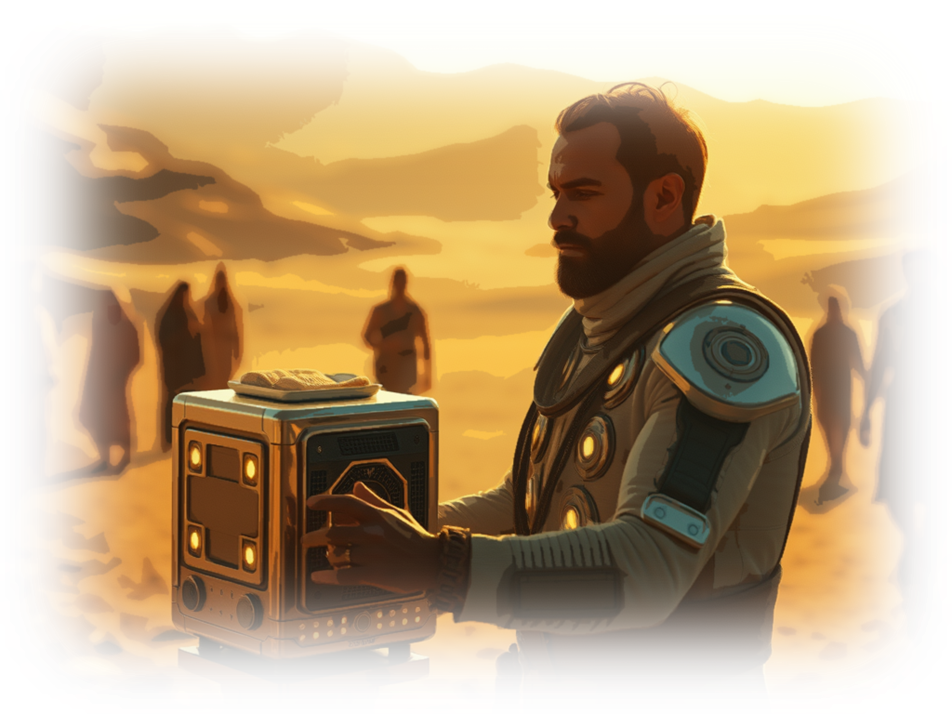
“With so many wild stories coming out of Egypt, I had to investigate,” he said. “The Egyptian accounts made me suspect that one of our kind helped their slaves escape. And when I finally found the freed slaves and saw this-” He held up a compact food replicator, “my suspicions were confirmed.”
He continued with a smirk, “The Federation does not look kindly on those who intentionally contaminate primitive worlds with advanced technology.”
“Oh, spare us the holier-than-thou routine,” Angelica said sharply. “I know you’re not exactly working within Federal law either. Otherwise, why would you keep aiding them? And I can clearly see you gave their leader anti-aging treatments.”
She gestured toward her former friend, still preaching nearby. “Care to share your permit for that kind of prolonged ‘research’?”
The man only smiled.
“I didn’t think so,” she said. “So, what exactly are you doing with these people? When I left, they were walking into the desert. I gave them that ‘magic stone’ so they wouldn’t die there.” She nodded toward the replicator. “It should have run out of power decades ago. And why does he still look young when everyone else I helped has died?”
“I had a hand in that,” the scientist replied. “When I found them, I saw that one of our kind had helped them escape Egypt. Since their development was already interfered with, I decided to conduct an experiment.”
He gestured toward the surrounding people. “I kept them in the desert for decades. When they neared its edge, I would whip up a sandstorm to push them back. Once, I even put them in hibernation and returned them to the center of the desert. The data I gathered…”
He ticked off points: “Their willful dependence on a magic rock for nourishment. Their blind faith that a god watched over them. The hardiness and discipline forged by the desert. The training regimen I gave them to mold a massive army of fanatics seeking a promised land, now within sight.”
He smiled coldly. “Your ‘friend’ was all too eager to do my bidding, and it was his idea to slaughter every outsider along the way. One primitive savage is much like the other, so I saw this as a waste of time and effort, but he insisted.” With a thoughtful shrug he continued, “In a way, it’s smart. Remove the indigenous population and plant your own colony without the distraction of assimilating another culture. I might even suggest it to the Federation Navy someday.”
“Perhaps I will introduce them to the doctrine first-hand when I-“
Angelica’s son returned, carrying three mugs of hot tea. He offered one to his mother and one to the scientist.
“Oh, such good manners your son has,” the man said, sniffing the tea. “Is this spice-herb from Elyria?”
“Yes. I brought some to drink in private,” Angelica replied, giving her son a pointed look that said he shouldn’t have shared it. “But seeing another Citizen must have reminded him of proper hospitality.”
He took another sip, basking in its aroma and flavor. “It’s been years since I’ve had Elyrian spice-herb. Thank you, son, for this kind gift.”
He paused to appraise the boy, “It’s too bad that I’ll have to kill you both. I just can’t risk you spoiling my plans.”
A rough cough broke his words.
“Excuse me. Sometimes the dry, dusty air gets to me.”
He coughed again, this time harder, before continuing. “Having such respectful youth as you is a delightful surprise. But-” Another cough, then a rasp. “It’s time to die.”
The coughs deepened into choking. His eyes locked on the “polite” boy with sudden horror, and in that same instant, Angelica realized what her son had done.
The man roared in rage and yanked a standard Federal laser pistol from his belt, but the poison was already freezing his muscles. The weapon slipped from his grasp and clattered to the ground, followed swiftly by the man himself.
“A surprise indeed,” Angelica said evenly as he lay gasping for air.
She turned to her son, her expression a mixture of shock and faint horror, as the poison finally stilled the Federal’s heart.
“He said he was going to use these people to do even more evil,” her son said, his voice tight. “I had to stop him. I could sense he was going to kill us. And his own words suggested he planned to use these people to attack the Federation garrison here. It was my duty to sto-”
“I know, son.” Angelica drew him close. “It was necessary.”
That night, she went to the tent of her former friend and found him weeping over the loss of his source of power. Angelica felt no sympathy.
She pointed at the dead Federal lying nearby. “Join me, or join that man in death. I will give you one day to say goodbye and name a successor.”
She hurled the compact replicator onto the ground. Its internal components shattered with a sharp crack.
“Tell your people you are being denied entry to the Promised Land because, instead of speaking to the replicator- your ‘stone’ to bring forth water, you struck it. This act of abusive disobedience is why you will go no further.”
Her gaze was cold and unyielding. “Say that to your people. But you and I both know I am punishing you for twisting my good deed into something evil.”
The man chose death.
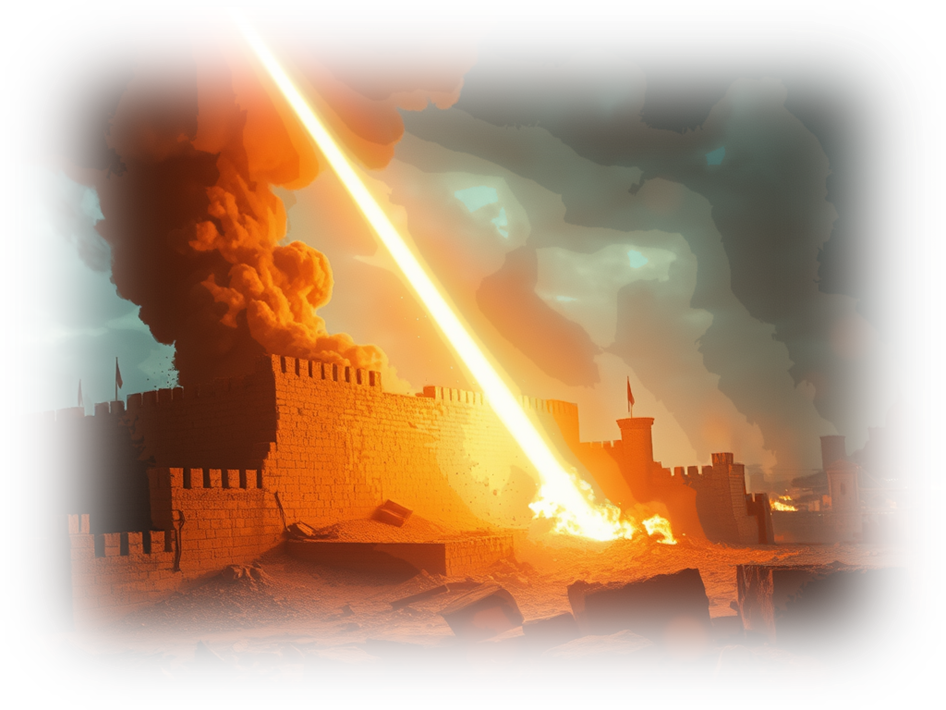
He walked out into the desert alone, leaving his people behind. Angelica lifted her ship into the air and followed from above. When he had reached a safe distance, the purifying light of a particle beam cannon at low setting washed over him.
There was nothing left.
***
But the damage was already done. His successor continued the invasion, and the genocide.
Angelica could not bear to watch, and left the planet.
From time to time, her son made discreet inquiries to the local garrison. On one occasion, they reported a single, small good that had come from the Federal Citizen’s interference.
During their campaign, the former slaves encountered a rogue AI ruling a sizable kingdom. The AI had given its people order, taught them how to build better tools, and shared knowledge of locating rare and valuable resources. In return, the locals worshiped it as a god and obeyed its command to conquer the planet.
The two peoples clashed, and the former slaves prevailed, destroying the AI. Unfortunately, none of the AI’s subjects, nor the knowledge and skills it had imparted, survived.
The victors slaughtered every last man, woman, and child.
My name is Angelica, and I am a merchant of death. My crew and I crashed on this planet, and a primitive man saved us. Though my crew made it off the planet, I owe this man my life, bound by honor to fulfill any request within my power.
He asked me to help free his people from slavery. A noble cause, I suppose, but not without complications. This place is under Federation control, and they don’t like me very much after I sold weapons to their enemies during the last Elodi-Fedy war. So, using modern weapons to bust his people out is out of the question.
The Federation’s agents on this world pose as gods to these people, manipulating them through religion. If I’m going to succeed, I need to take a page from their book and disguise my actions as superstitious miracles. With luck, they’ll think it’s just another secret project one of their “gods” is running.
Snake-Staff
This guy has anger issues, so he’s bound to get into a fight. The first thing I did was replace my friend’s wooden staff with something more… impressive. I loaned him a robotic snake I usually wear as a belt, but reprogrammed to disguise itself as a staff. It’s solid and sturdy, perfect for walking, but whisper the passphrase “Snakey-Snake,” and it transforms into a living snake, programmed to defend its owner.
When I handed it to him, he couldn’t wait to show the Pharaoh’s magicians the “power of his God.” He came back grinning ear to ear, saying the staff worked flawlessly. Unfortunately, the Pharaoh wasn’t impressed.
I told him a simple magic trick won’t make a king give up his free labor force. If we want results, we’ll have to make Egypt suffer. Luckily, I have tools in my arsenal to make life so miserable for the Egyptians that they’ll beg to be rid of him and his people.
Poison the River
Let’s start with their water supply. I had containers of Ferrite Rubrum and pulverized beetroots gathering dust in my cargo hold. Ferrite Rubrum dissolves instantly in water, turning it a deep red-brown that looks and tastes like blood. Add the beetroot, and the effect becomes even more grotesque. The water thickens, becomes murky, and carries a faint iron scent. It’s convincing enough to pass as blood to any primitive.
This chemical binds to organic matter like algae or silt, keeping the illusion intact for days before breaking down harmlessly. And no lasting damage means the Federation can’t accuse me of environmental harm, if they even notice it at all.
All I had to do was poke holes in the containers and drop them upstream. As the chemical spread, the river turned blood-red.
***
The plan worked perfectly! Maybe it worked too well. Most of the fish in the river died, and I doubt anyone dared to drink the water for three days.
Frogs!
A few days after the water cleared, my friend returned the water replicator I loaned him to keep his people hydrated. It looked rough, like he’d thrown it in frustration.
His temper is going to be his downfall one day.
Anyways, this Pharaoh still hasn’t freed his people, and now it’s time for an infestation of… frogs. I have tons of genetically engineered frogs in stasis left over from a mission to destroy the ecology of Antares VI. There’s enough to cover an entire city! But first, let’s infest them with parasitic larvae that will kill them in two days and feast on their corpses before becoming yet another pestilence on these oppressors.
I warned my friend that, by the next morning, the entire city will be covered with frogs. They will be everywhere, even in their own homes. His people must endure for two days, then clear out the dead frogs immediately. Do not let a single frog linger or it will expose the slaves to another pestilence I have planned.
He acknowledged my instructions and left to warn his people.
That night, I flew my cloaked dropship over the city, releasing the frogs. They infiltrated homes, ovens, and beds, spreading chaos everywhere.
That night, I flew my cloaked dropship over the city and unloaded my cargo of frogs onto an unsuspecting population. The frogs hopped and crawled everywhere in the city. They swarmed into homes and even found their way into the Egyptians’ beds, ovens, and cookware.
Every frog died in two days, but nothing happened. The larvae didn’t hatch and my friend’s people were still enslaved.
Something wasn’t right.
Lice Aren’t Nice
I had a backup plan ready in case the flies didn’t pan out, so I fired up my dropship and released shredded cloth infested with lice over the heart of the city. I made sure to avoid the slave quarters, limiting their exposure to the infestation.
This should cause plenty of irritation among the Egyptians. At the very least, it’ll buy me time to plan something more severe for them.
The Lord of the Flies
Looks like I spoke too soon about the larvae. It took longer than expected, but they’ve finally hatched, and now the flies are everywhere!
These pests are remarkable. They swarm so thickly that people are choking and vomiting after accidentally inhaling or swallowing them. I had to give my friend some bug repellent to protect his people’s homes.
Call me the Lord of the Flies! These winged nightmares are doing exactly what I hoped they would.
Livestock Pestilence
Let’s start killing stuff. Maybe the loss of their animals will push them to release their slaves. For this, I dusted off a zoological plague I previously used on Antares VI. I’ve been studying the local livestock and the viral agent will definitely kill them.
I spent a few days inoculating the slaves’ livestock to protect them from the disease. To make things easier, I designed special feed laced with the vaccine and gave my friend strict instructions to distribute it to every animal in their community.
I also warned him that it’s not for human consumption. But if someone eats one by accident, they should survive, probably with an upset stomach at worst.
I kept checking in to make sure everything was going according to plan. When I saw a few sickly animals in the slave quarters, I insisted they be slaughtered immediately to avoid ruining the miracle I planned. I convinced my friend it had to be done, but the slaves resisted. The penny-pinching owners agreed, but only after I offered shiny coins for each one.
Word spread fast, and soon, other slaves were eager to sell their livestock for a quick profit. I had to step in and warn my friend that if this kept up, they’d ruin everything. I also warned him that if any cattle had deadly accidents, I’d stop helping entirely.
Thankfully, the rest of the preparation went smoothly. The day before releasing the plague, I sent my friend to the Pharaoh with an ultimatum to release his people, or a terrible plague would wipe out all the Egyptians’ livestock, leaving only the slaves’ animals unharmed.
That night, I unleashed the biological agent over the city.
By morning, every Egyptian animal was dead or dying.
A-Pox
I killed the Egyptians’ livestock, sparing that of the slaves, and yet, this Pharaoh remains unyielding. His people seem ready to see the slaves leave, but he is harder than adamantium.
It’s time to leverage the people’s exhaustion with this conflict. My next attack targets the human population. In my cargo hold is an aerosolized A-Pox bioweapon I had planned to sell to mercenaries fighting the Elodi. While lethal to the Elodi, for humans, it’s relatively mild. The unvaccinated suffer from bumpy, pus-filled rashes, and the mortality rate is only 10%.
None of the slaves can be infected. If even one shows symptoms, the “miracle” is ruined. I personally distributed the vaccine to ensure there were no mistakes. Every slave received it, including the sickly and elderly, whom I allowed to take shelter on my ship as an extra precaution. I waited six days to ensure the slaves built an immunity before releasing the virus over the city.
The effect was immediate.
Festering boils erupted on Egyptian skin, leaving the slaves untouched. Panic spread as the people begged the Pharaoh to let the slaves go, their faith in him fracturing. Watching their suffering wasn’t easy, but if this doesn’t break him, I will be forced to think of something far worse. For that, I’ll need some more time.
Hail from Hell
What does it take to convince this Pharaoh?
I killed their livestock and unleashed A-Pox upon the people.
I need some time to think of more gruesome things to do to these Egyptians. I can convince a plague of locusts to swarm the city and even increase their numbers, but it will take about a week for them to get here. In the meantime, I’ll unleash a deadly hailstorm using one of my weather control devices. I’ve got twenty of these handy gadgets, so losing one is no big deal. Besides, I’ll still have plenty to sell when I visit the agricultural colonies.
My friend gave the Egyptian king the ultimatum, and it was rejected. The next day, I flipped the switch on the device. Thunder, hail, and lightning rained down on Egypt, creating the worst storm in the nation’s history. Hail struck everything in the fields and only left destruction in its wake.
But the slaves? They were safe under the protection of a mobile shield generator I deployed.
Locutus of Locust
The locust swarm is almost here, scheduled to reach the city by tomorrow morning. My friend delivered another ultimatum to Pharaoh, and he refused to free the slaves. Honestly, that’s a relief. I had no idea how I would’ve stopped the locusts if the slaves were freed.
At dawn, the winds carried the swarm into Egypt. The locusts invaded every corner of the land, blanketing the ground until it turned black. They devoured everything the hailstorm left behind, leaving nothing green on trees or plants. The entire land of Egypt was stripped bare.
And yet, Pharaoh still wouldn’t release the slaves.
Consuming Darkness
I had enough time to plan two more horrors for these people. Since the Egyptians worship a sun-god, I figured it would be poetic to rob them of sunlight. While I couldn’t eclipse the sun without drawing too much attention, I decided to weaponize another one of my weather control devices instead.
I programmed the device to produce a dense fog laced with carbon black and graphite nanoparticles. These absorbed and scattered light, creating near-total darkness. To make things worse, I added sulfur compounds to the mix, creating an acidic, choking miasma that clung to everything.
I didn’t even bother giving Pharaoh an ultimatum this time, I just flipped the switch.
The fog enveloped Egypt, plunging the city into an impenetrable blackness. For three days, no one could see or move. The suffocating air added to their despair. Meanwhile, the slaves had plenty of light where they lived.
The Egyptians trembled in fear, but even this wasn’t enough to secure the slaves’ release.
Firstborn Death
The slaves remained in chains. Despite all the pestilence, hailstorms, darkness, and death I’ve unleashed, Pharaoh still clings to his slaves, and the people of Egypt won’t rise to force his hand.
Before I resort to more direct measures, like using my ship to send a “lightning bolt” to end Pharaoh, I’ll try one last thing. During the days of darkness, I worked to scan every living creature in the city, mapping their genomes to program another weapon. I prepared a container of self-replicating, aerosolized grey goo. This weapon is difficult to program, but I managed to narrow its targeting parameters to only kill the firstborns in the city. Unfortunately, I can’t fine-tune it any further.
To fix this, I instructed my friend to have the slaves mark their homes with a special “blood” that would repel the goo. Supplies were limited, so they opened their homes to neighbors who wished to be spared. As the slaves prepared, my friend delivered Pharaoh one final ultimatum.
When he returned without the emancipation of this people, I released the grey goo. All the unprotected firstborn of Egypt died that night, from the firstborn of Pharaoh to the firstborn of prisoners and livestock. The entire land was filled with wailing, for every house was touched by death.
Pharaoh relented that very night, and my friend’s people were freed. Fearing what might happen next, the Egyptians urged the slaves to leave immediately.
Passing a Sea
After their release, my friend and his people marched until they reached an inland sea. They camped on its shores while we debated how best to get around this obstacle. But my ship’s sensors soon detected a massive army approaching from the Egyptian capital.
There was no time to circle the sea. We had to go through it.
I instructed my friend to prepare his people to cross. Then I piloted my ship over the sea, activating its tractor beam. A blinding blue light sliced through the water like a knife, creating towering walls of water on either side of a newly formed path.
The refugees stood in awe, many dropping to their knees in prayer. But with the army closing in, I sounded the ship’s horn to get them moving. One by one, they carefully stepped onto the muddy seabed and began their march.
They were halfway through when the Egyptians reached the shore. My sensors showed the army paused in hesitation, but pride and arrogance won out, and they soon charged into the passage. The Pharaoh’s forces gained ground quickly, but the refugees were just steps from the far shore.
I disengaged the tractor beam in timed sections, allowing the stragglers to reach safety. Then, with a roar like thunder, the towering walls of water collapsed, swallowing Pharaoh’s army whole. From my cockpit, I watched the torrents sweep away every last soldier.
The refugees cheered as they stood safe on the other side. They celebrated not only their safety but also the realization that they were finally, truly free from Egypt’s grasp.
I was happy, too. I delivered these people to freedom, but now I wonder about the cost?
Journey Beyond the Sea
To celebrate their newfound freedom, I shared a hallucinogenic tea with my friend on the first night after crossing the Red Sea. The experience was both entertaining and surreal, as he seemed entirely at one with his god.
The slaves were free, and my debt was paid. Technically, I had no obligation to stay on this planet anymore. Yet, I couldn’t bring myself to abandon these people in the middle of the desert. I decided to assist them by providing food and water as they journeyed to their “promised land.”
As we plotted the route, I warned my friend that the land he sought was already inhabited, and its current occupants might not be eager to share. His response shook me: “It is our land by the right of God, and we will take it in His name. Only the chosen people will remain.”
The way he said it, with unflinching resolve, chilled me. I recognized that fanaticism, the same determination I’d seen in those I once armed for conquest. He had grown into a dangerous man, wielding religious authority and an army ready to follow him. I decided then and there that I would not aid him further once we reached our next destination.
I would not help him commit genocide.
Mount Cyanide
After two months of travel, we arrived at a mountain the slaves called Cyanide. What an ominous name, perhaps it’s tied to some ancient poisonings. I couldn’t understand why anyone would want to visit such a place, but my friend announced he would climb it alone.
I offered to fly him up, but he refused, saying he needed time away from the group. I didn’t blame him. For people who just escaped slavery, they were surprisingly ungrateful, complaining about every minor inconvenience. Frankly, it was driving me mad! I could only imagine what it was doing to him, especially with his temper.
I joined him once he reached the summit, and we celebrated the journey’s end with more of my special tea. I knew he was tripping hard when he began conversing with a bush that caught on fire from stray embers of our campfire. He claimed it was his God, dictating the Commandments of his people.
The next morning, I found him chiseling those Commandments onto two stone tablets. I offered to inscribe them using my tools to save time, but he refused, saying this was something he had to do himself.
I revised the last section of “Freedom Fighter in Egypt” (the first Angelica chapter). Recall that Angelica shared a hallucinogenic tea with her friend. She knew he was tripping hard when he began conversing with a bush that caught on fire from stray embers of the campfire. The man claimed it was his God, dictating the Commandments of his people. My goal with this revision is to introduce the Ninefold Light as the symbol of the Path of Luminism (Luminism).
Please revise this for readability.
A Message from Beyond
I had my own vision that night, as strange and brilliant as the firelit hallucinations of my companion.
I floated in null-gravity in a vast void of endless light. There was no ground or sky, only the infinite. From that emptiness, a shape emerged. First, a triangle of stars, perfectly spaced, each one shimmering like stellacite crystals that glow with a cool, living light when held. They seemed aware of me, drawing my gaze toward their shared center.
Around them grew a radiant circle. It was so pure and endless that I felt myself following its curve even though I never moved. It was not merely a ring, it was a path all beings had walked and would walk again, without beginning or end.
From this circle burst nine rays, evenly spaced, stretching into the void. They were more than light. They were voices made visible, soft yet certain, whispering truths I could barely grasp. I knew each ray carried a principle, a way of living that bound the soul to the betterment of all.
When I reached out to touch it, it vanished in a single flash, leaving warmth in my chest and the unshakable certainty that I had not seen a mere symbol, but a way of life. It was the Ninefold Light, and it is not meant not for me alone, but for all who seek wisdom and wish to leave the world better than they found it.
Then my mother appeared to me, long gone from the realm of the living, her voice was gentle but resolute. She spoke of redemption, telling me that freeing the slaves had been a great service, one that would echo across generations. It had balanced part of my moral ledger, but there was still much to atone for.
She gave form to the Nine Please Principles, those rays of wisdom that had whispered just beyond my understanding. She called them guiding pillars of light, meant to help others live well and to secure their place in a good afterlife. As I absorbed their wisdom, I felt her love pour into me.
And then, she was gone.
Whether her words were truly from the spirit realm or the deepest parts of my own mind, I could not say, but I knew they mattered.
When I awoke, I resolved to honor that vision. I had spent my life profiting from death and war, but now I would strive to make the universe better. Spreading the Nine Please Principles would be my first step toward redemption.
When I woke, I resolved to honor that vision. I had spent my life profiting from death and warfare, but now I will strive to make the universe a better place. Spreading the Nine Please Principles would be my first step toward redemption.
So, dear reader, I pass them to you now. They are a gift, a compass to guide you toward a life that leaves the universe brighter than you found it.
Jonas Morecock was the personal assistant to one of the pantheonic “gods” who governed the world. In his youth, he was the most beautiful boy in his Greek city and was taken as a teenager to serve as the god’s lover. Over time, Jonas’s boyish charm faded, but his intelligence set him apart. Recognizing his potential, the god kept Jonas in his service, training him to read and write so he could assist with administrative tasks. Jonas exceeded all expectations, becoming the god’s head assistant.
One day, the god gave Jonas a dangerous mission to return to his hometown and warn its people to repent for defying the gods, or face destruction. Jonas knew he would be killed if he went back. Fearing the task was a ploy to dispose of him, Jonas defied the god’s command for the first time in his life, fleeing aboard a ship heading in the opposite direction.
The god, angered by Jonas’s defiance, used a weather-control device to conjure a violent storm. The terrified sailors, believing Jonas was the cause, threw him overboard to appease the sea. Their betrayal of Jonas enraged the god even more. He obliterated the ship with a beam of energy, which Jonas mistook for lightning.
As Jonas struggled to stay afloat, the god’s anger softened. He ordered a nearby submarine to rescue him. Exhausted and on the verge of drowning, Jonas fainted as he saw what he thought was a whale opening its mouth to swallow him.
The submarine crew sedated Jonas for most of the journey. On the final day, they woke him to speak with his god via a viewscreen. Jonas apologized for his disobedience, and the god forgave him. The submarine brought Jonas near the city he was meant to warn. To onlookers on the beach, it appeared as though a whale had beached itself and spit Jonas out.
Awed by this miracle, the townspeople escorted Jonas to their leader so he could deliver the god’s warning to repent. From the king to the commoners, the people wholeheartedly turned from their wicked ways and pledged to follow the will of the gods.
Moved by their repentance, the god spared the city. But Jonas was furious, feeling the city deserved punishment. Amused by Jonas’s hypocrisy, the god reminded him of his own recent disobedience and forgiveness. He used Jonas’s experience to teach him about mercy and the value of saving lives.
Jonas returned to his god’s service, continuing his duties until his death at 44. Ironically, he passed away while lying next to a Greek geek by a creek, which is proof that even the most extraordinary lives end in simple moments.
In a small, dusty desert town lived a virgin named Mitzi, daughter of a proud sheep herder. Her father took great pride in his flock, until the day one of his sheep gave birth to a deformed lamb.
It was completely bald.
A hairless lamb was useless to a herder, and worse, it was seen as a bad omen. The villagers believed such deformities were signs that the village god was angry, and that his curse had fallen upon the family.
Fearing what the others might say, Mitzi’s father prepared to kill the lamb. But Mitzi felt something unusual in the creature, something rare and precious.
She begged her father to spare it.
He refused at first. But she pleaded so desperately that he relented, on one condition: the lamb must never be seen by anyone.
Not even him.
Mitzi agreed and raised the lamb in secret. Time passed, and one day, the lamb grew golden fleece. Overcome with pride, she paraded the lamb through the village.
The townspeople were amazed by the sight of a lamb with shining golden fleece, and they began to sing in celebration:
“Mitzi had a little lamb, its fleece was golden so. Everywhere that Mitzi went, the lamb was sure to go.”
Even her father, who had once cursed the lamb’s birth, was astonished. The deformed creature had become a miracle. But the miracle came with a price.
The village god was a man.
He was a man with advanced technology and machines that the people mistook for divine power. From time to time, he visited the town to remind the villagers of his presence. On his last visit, he had experimented on her father’s flock.
When he heard news of the unusual lamb, he returned to the village to see it himself. The experiment had worked!
The lamb was of interest to him, but it was Mitzi who captured his attention. He was mesmerized by her beauty, and he decided he must have her.
He sent a mechanical “bee” to sting her, rendering her unconscious. Then he took her to his remote outpost, where he violated her sleeping body. When he was finished, he returned the sleeping beauty to her home.
Mitzi never knew what had been done to her… until her belly began to swell with new life.
News of the virgin pregnancy soon reached the village god. He cared nothing for the child. The hybrid was inferior in his eyes, unworthy of his time. But he feared that allowing a “divine” child to be abandoned would set a dangerous precedent. And so, he sent one of his assistants to deliver a message to Mitzi.
The messenger was a woman, disinterested and unenthusiastic about being sent on such a mundane task. She appeared before Mitzi, pointed at her growing belly, and spoke:
“I just met you, and this is crazy, but God just raped you… go have his baby. It’s hard to look right at you, lady, so please remember, don’t kill his baby.”
And with that, she left.
Mitzi did as she was told. She raised the child alone.
The villagers worshipped the baby, calling him the son of a god. But he grew up to be nothing remarkable. He performed no miracles, offered no revelations. His only divine trait was the story of his birth.
There was once a man who believed he was favored by the universe. Each day, he prayed beneath the blazing morning sun. He made offerings on a barren hillside, always exposed to the elements. He sought guidance as the sun dipped behind the horizon, and over time, he began to hear a voice.
At first, the voice whispered gentle thoughts into the back of his mind. It told him he was doing good work. That he had purpose. That he, out of all the sentient beings in the universe, was chosen by divinity.
The man listened closely.
Then, one morning, the voice said something new:
“If you truly believe,” it whispered, “you must offer up your child.”
The man was shaken, but also afraid to disobey. What if this was a test? What if failing to act meant punishment, or rejection from the divine?
So, he obeyed.
He lied to his child, saying they were going on a lovely picnic. The naïve boy didn’t question it, even when he noticed they hadn’t packed any food.
They climbed the nearest mountain, the man carrying only a knife and a bundle of firewood. At the summit, he built an altar and gently bound his son’s hands.
The boy was confused but not afraid. He remembered seeing his father and mother play strange games before bed. He thought this might be another one.
But in the father’s mind, something had shifted. The voice was no longer whispering, it was urging. It called this “the price of faith.”
The boy’s smile faded as he saw the blade.
His eyes widened with terror as his father raised the knife.
And just before it fell, the voice boomed:
“Never mind! I was just kidding.”
“Wow… you were really going to do it! You’re completely messed up, man.”
The man laughed. The voice laughed.
Even a nearby goat let out a braying chuckle.
But the child never laughed again.
He never trusted anyone again.
He spent the rest of his life alone.
Reflection
Luminism warns against confusing faith with obedience, and reverence with recklessness.
No truly good force in the universe would demand the death of a child to prove loyalty.
And no loving, clear-minded parent would comply without question.
Do not glorify voices that command violence.
Do not celebrate faith that sacrifices others to prove itself.
The true test is not whether you will follow an unproven command. It is whether you will question it, especially when it defies love, reason, and life.
“If your beliefs require blood to be proven true, then it is time to question your faith.”
Let your conscience be your compass. Let evidence be your light. And if a mysterious voice urges you to kill someone, let a licensed psychiatrist be your guide.
Long ago, a so-called god looked upon the world and didn’t like what he saw.
There were many animals, both gentle and fierce. There were majestic unicorns, a handful of dinosaurs, a subterranean civilization of Pomeranians, and another of reptilian scholars. Above all, there were free-thinking humans.
This god, however, had plans for the land. He viewed these creatures, especially the independent-minded humans, as potential interlopers. Worse, they weren’t groveling or offering sacrifices. They weren’t even afraid.
This would not do.
So, the god resolved to wipe them out. Most of them, anyway.
He found one man he liked, and decided to spare him and his family. He was not chosen for his wisdom or virtue, but for his blind obedience.
The god instructed this man to build a massive ship, an “ark,” to preserve a sample of life… specifically, the parts the he approved of. The man obeyed, but had no experience in shipbuilding and what he built resembled a soggy raft.
This would not do either.
So, the god secretly dispatched robotic servants to complete the project and, while he was at it, installed dimensional tech to make the interior larger than it appeared. This ensured the vessel was spacious enough to house all the creatures the god intended to save.
He commanded the man to gather two of every species. For the dangerous or evasive ones, he gave him tranquilizer gear and simple stasis tools. But the man, ever clueless, overdosed several animals… killing them outright. Replacements had to be sourced, and eventually, one of his more competent daughters was reassigned to the task.
Later, it was discovered that the man never checked the sex of the animals. He brought pairs to the ship, but some were both male or both female.
Meanwhile, the god unleashed his plan:
He triggered unceasing rain through weather control devices.
He redirected rivers using terraforming tools.
He activated a gravity well generator that was hovering in low orbit to hold the floodwaters in place.
The twin cities of the reptilians drowned beneath the tides. And his robotic servants hunted the survivors down as they fled to the surface.
The subterranean Pomeranians fared no better. The god shattered the land bridge holding back the Atlantic Ocean and water crashed through ancient tunnels to bury their basin cities in brine.
And the humans?
For nearly two months, the land was submerged. Just long enough to wipe out the undesirables, and to leave a lingering threat for the survivors. He didn’t kill all of them, just the ones who lived in the region he coveted. The rest, far from the flood zone, were spared purely by accident.
When the rain finally ceased, a rainbow arced across the sky. The god claimed credit for this natural phenomenon and declared it a sign. Not a promise of peace, but a veiled threat: “Next time, it’ll be fire.”
When the ark finally landed, the god inspected the preserved animals and discovered the problem.
Two male unicorns grazed beside the ramp.
He glared at the man. “Did you even check the genders?”
The family suddenly found the nearby rocks very interesting. Alone, the man stammered, “No, uh…”
The god grumbled, suppressing his anger. The man was, after all, loyal. Gullible, yes… but most importantly, loyal. So, he was assigned the task of catalog each animal and mark which pairings were unusable.
Thankfully, the error rate was low.
More curious, though, was the fate of the Spectrumgobblus or Rainbow-Colored Turkey. Records showed two had boarded the ark, but only one remained.
The god narrowed his eyes.
He remembered briefly inspecting the family mid-voyage. He saw a rather large roasted bird on the dinner table, but…
…surely, they didn’t?
Did they?
Reflection
The flood myth is a cautionary tale that serves to highlight something deeply troubling about the types of deities humans have historically chosen to worship. Most are all-powerful, demanding of loyalty, and wrathful at disobedience. All while exhibiting petulance and indifference to the cruelty done to others.
In Luminism, we ask:
What kind of god needs to kill to teach a lesson?
What kind of wisdom is proven through genocide?
And what kind of people call that holy?
This story forces us to confront the reality that morality cannot simply be what a powerful being commands. Obedience is not inherently good. In fact, blind obedience to unjust authority is often the mechanism by which great evil is carried out.
In the end, this isn’t a story about salvation. It’s a story about selective survival, enforced conformity, and the kind of god who mistakes domination for righteousness.
If your god demands the death of others to prove his glory, he may not be worth following.
In the city of Primora, there once lived a god named Orvox. Orvox had forged the mountains with a clap, kindled stars with a breath, and molded the first humans from dust and thought. His power was unmatched and his intellect vast.
And yet…
Every seventh day, he grew anxious.
He would descend from his shining citadel and demand that people gather. They were to sing his praises, light candles, kneel, chant, and speak of how good and wise he was. If any failed to appear, Orvox grew sullen.
“If you do not worship me,” he declared, “you dishonor the gift of life I gave you!”
One day, a philosopher named Etta stood before him, unbowed.
“I mean no offense, Great One,” she said calmly. “But if your gifts must be repaid with loyalty and praise, are they gifts at all?”
Orvox scowled. “You dare question me?!”
Etta continued, “You made us flawed, curious, fragile. And when we stumble, you scold us for not being perfect. You gave us thought, and now you resent us for using it.”
“I created the rules,” Orvox thundered. “It is not your place to question them.”
Etta tilted her head. “But it is in our nature to ask questions. You put that in us too, didn’t you?”
Orvox was silent.
And so, the people began to think. Some still worshipped, but others pondered. They asked themselves:
What kind of god builds creatures with imperfection and then punishes them for it?
What kind of being demands love, but only under threat?
Eventually, Orvox grew weary of their independence.
He vanished.
Over the centuries, the people of Primora grew, not in piety, but in philosophy. They learned to take responsibility for their mistakes, rather than blaming unseen forces. They built temples not to gods, but to compassion, to knowledge, and to the betterment of the self.
One inscription in the Hall of Reflection reads:
The truest divine does not crave praise.
It builds and then lets go.
It creates and trusts the creation.
Reflection
Luminism teaches that any being, divine or mortal, who demands obedience without reason or praise without merit, is not a model of strength.
It is insecurity.
True wisdom does not need worship to prove itself. Just as true love does not require constant affirmation to remain. If a god demands applause more than justice, and punishes curiosity more than cruelty, then perhaps it is not a god to be followed.
It is a cautionary tale to be studied.
Your reverence should be earned, not expected or required. Whatever questions you develop should be welcomed, not silenced. And if you ever meet a “supreme being” who fears scrutiny…
It might be a sign that you are more enlightened than they are.
Long ago, before textbooks and telescopes, there lived a village tucked beneath a sky so full of stars that it seemed the heavens were a bowl spilled with salt. The people of the village believed the stars were holes poked in the sky by a giant cat, so that divine light could shine through from the other side.
The cat’s name, they said, was Moggie the Eternal, and every time a star appeared, it was because Moggie had sharpened her claws in the sky. “Poke,” they’d say. “A new star is born.”
Children smiled at this. Elders nodded. And no one questioned it… except for a girl named Lin.
Lin loved the stars, but she also loved questions. She asked why some stars twinkled and others didn’t. Why they moved with the seasons. Why some suddenly disappeared.
“Moggie is mysterious,” the villagers would say.
But Lin wasn’t satisfied with mystery for mystery’s sake. So, she began to study. She watched the skies, drew charts, and learned from travelers who passed through with stories of far-off observatories. She built a lens from river glass and bronze scraps. She charted constellations on goat hide. She learned the stars were not holes in the sky, but distant suns, each burning in the cold darkness of space.
At her side was a small cat of her own. He had soft gray fur and a determined little face. His name was Kobiyashi[1] Maru or “Maru” for short. Whenever Lin grew frustrated with the villagers’ resistance, Maru would walk straight into the walls of her workshop.
Thump.
Sometimes once. Sometimes over and over.
It started as clumsiness. But in time, Lin realized it was empathy. A cat trying to understand the invisible barriers she faced. A cat who walked into walls because he knew she did, too.
When Lin shared what she learned, the village scoffed.
“That’s too complicated,” said the baker. “Stars can’t be suns. They’re too small.”
“I don’t get any of that,” said the priest. “You can’t even see all that stuff without a magic tube. If I don’t understand it, it must not be true. God did it. End of story.”
Lin kept going. Because Maru kept walking.
One night, an old woman approached her, gazing at her maps and lenses.
“I remember when I thought Empurress Moggie poked holes in the sky to make the stars,” she said. “But now I see that truth doesn’t need to be simple to be beautiful. Understanding can be a form of worship too.”
Together, they watched the night sky.
Not as a mystery to be feared.
But as a puzzle waiting to be explored.
Reflection
In Luminism, the pursuit of knowledge is sacred. Mystery is not our enemy, but neither is it an excuse to stop asking questions. When we meet a gap in understanding, we must not fill it with gods out of habit or fear. We must fill it with curiosity, evidence, and wonder.
To say, “I don’t know,” is honest.
To say, “I don’t understand, so it must be magic,” is surrender.
There is no shame in not knowing. But there is danger in pretending that ignorance is the end of inquiry.
And if you ever find yourself walking into walls out of frustration, exhaustion, and for being misunderstood, know that even in those moments, you are not alone.
Maru walks with you.
Lin walks with you.
And so do all who choose to question.
Let your questions be the lens through which light grows sharper. And never be afraid to ask why.
[1]Kobiyashi Maru – “Kobiyashi” is misspelled on purpose.