Luminism is a modern philosophy and religion of reason, compassion, and moral clarity. It teaches that goodness stands on its own… not on dogma, not on fear, and never on threat of divine punishment.
[1] I lived for several hundred years, traveling across the world. I’ve wandered through vast deserts and scaled many mountain ranges. I visited lands where the people’s eyes are long and narrow, and from there, I bid farewell to the Han and journeyed into a realm of endless winter. For a long time, I regretted entering this desolate land, but eventually, I emerged into a wide expanse of plains.
In this region, I encountered people with long hair, broad noses, and deep-set eyes. They were kind, guiding me southward through dense jungles. I wandered through these jungles until I reached the southernmost tip of the world. After many years, I returned to the great plains, deciding that my travels had been enough.
I asked a local tribe if I could build a home, and they led me to land that belonged to no one. It was there that I met the Bullfrogi. Beneath the surface world, they had built a remarkable civilization, and from them, I learned much about the heavens and the stars.
The Bullfrogi spoke of a spacefaring civilization known as the Federation. However, when I shared my diary, recounting my experiences with Jesi, they grew anxious. They explained that Jesi had been influenced by a great enemy of the universe… the men who always wear black.
Now, I am old and weary. I entrust this diary to the Bullfrogi, for they have promised to protect its knowledge and share it with my people when the time is right.
I don’t know you, dear reader, but I beg you to share what I have recorded here. Do not let humanity fall once again into religious slavery, deceived by false gods. We did not understand before that other beings exist in the universe who wield tools of unimaginable power and possess superior biological abilities.
We can become like them, but only if we open our eyes to the truth.
This story is part of a collection of narrative entries, eyewitness records, and sacred illustrations documenting the rise and fall of the false god known as Jesi. This account spans many pages and includes artistic depictions and individual miracle stories recorded by a witness whose voice grows ever more strained under the weight of truth.
This story is part of one continuous chronicle. Treat each section as a chapter within the same diary. Each page is part of a fragmented gospel of a false messiah, exposed through the steady hand of one who dared to witness.
As you read, keep in mind that this is not a story of salvation. It is a cautionary record, and like all cautionary tales, its lesson may arrive only after it’s too late.
[1]It has been over a month since the angel of death fell from the sky and wiped out the two armies. Before departing, the Lieutenant ordered us to follow a path he marked on the waterproof map and spread the word about Jesi, the god who blesses his most faithful with miracles.
We travel by day and spend our nights preaching to the townsfolk. At first, the people were doubtful, but my fellow villagers had already done their part in other cities. In one town, a woman mentioned a trader who had spoken of Jesi’s miracles. When we heard others repeating similar stories, it became easier to convince the people of Jesi’s power.
One night, the stars above shone brighter than I’ve ever seen. Some of them grew so bright, the birds started singing their morning songs. We used this strange event as proof of Jesi’s holy war against the nonbelievers. Many towns along our route witnessed it too, and were even more receptive to our message after that.
But not everyone believed. In one city, a priest interrupted our preaching, claiming that the celestial lights were a sign of Baal’s power. He called us heretics, and soon a mob formed. They drove us out of the city, and we lost most of our supplies.
Four men from our village were killed in the chaos.
We moved on to our next destination and were greeted midway by the Lieutenant. He was annoyed that we weren’t following the planned schedule and furious about the lost supplies. But when we explained what happened, his anger shifted to the city.
He promised that those who attacked Jesi’s servants would be punished. He gave us coins for new supplies and instructed us to rest an extra night in the next town to recover our strength. As we set out, we saw a fiery angel streak through the sky, headed toward the city that had cast us out.
A week later, a trader told us of a city where every inhabitant had choked and vomited themselves to death. On its walls, the name Jesi had been written.
Today, we reached the last town on the map Jesi gave us. An arrow on the map pointed us toward an unknown destination. We were afraid of venturing into the unknown, but we had no choice. Jesi’s will must be followed.
After crossing a large hill, we found Jesi sitting in the shade of a pavilion. He was surrounded by men and women dressed like him, and among them was the Lieutenant. An army of servants attended to them.
Jesi smiled as we approached. He invited us to sit at a table and praised us for our work. As a reward, he was going to take us to his stronghold to witness the wonders of his city, and then we are to spread word to other cities that Jesi seeks followers to join him.
After an hour of rest, a fiery eagle swooped down and landed near the pavilion. The side of the thunder-bird opened up, revealing stairs. We were ushered inside and bound to chairs as though we were cargo. Jesi and his Lieutenants retreated into a sealed compartment at the front of the bird, with a strange glowing sign above the door that read FIRST CLASS.
Suddenly, the bird lurched into the air, and I felt my stomach drop. We screamed, watching the ground fall away beneath us. I saw some of the Lieutenants laughing at us, but I was too overwhelmed to care. My mind raced with fear, wishing the bird wouldn’t become sick and vomit us out to our deaths.
Just when our nerves began to calm, the bird saw its nesting place. It was a circular city with great towers in the center. When the bird finally descended, I hoped our terror had ended. But as it dropped toward the ground, it seemed like we would fall to our deaths. At the last moment, the bird slowed down with such force that it felt like an entire village stood on my chest.
Once the bird settled on the ground, the Lieutenants laughed at us as they untied us from the chairs. It was done with such contemptuous ease that we could have untied ourselves if we only knew to lift a simple lever.
We stumbled out of the bird, some of us kissing the ground in relief. I overheard a man, a strange one wearing a hard hat, arguing with one of the Lieutenants about “safety regulations” and “being reported.” His complaints died as soon as Jesi appeared to dismiss the matter, The man, towering and stern moments ago, shrank under Jesi’s gaze, he bowed deeply and mumbled apologies before returning to his other duties.
Distracted by the scene, I barely registered my surroundings until I looked up. I was in awe. We stood in a vast city of buildings that towered into the sky. The structure at the center was much taller than the rest, and it seemed to reach heaven itself. Wingless birds flew between the buildings, moving in perfect formations. My mind struggled to make sense of it all.
Jesi told us to stay close to the Lieutenant, warning that everything in his city was dangerous to outsiders and might accidentally kill us. Then he stepped onto a moving path that carried him away faster than we could walk. By the time the Lieutenant gathered us, Jesi was gone.
The Lieutenant led us to something he called an “elevator” that will take us to “Counterweight Station.” We followed him onto a path that moved by itself, and I could only stare in confusion. It was like the ground itself had come alive, rolling us forward. As we neared the central tower, I noticed the path was made of wheels, like those on a watermill, but nothing else about it made sense to me.
Before I could understand more, a hand roughly pulled me through a door just in time, as something like a giant snake rushed past, its body gleaming and stretching as far as I could see. It moved faster than any creature should, and my heart pounded with fear. I was dazed and breathless as the Lieutenant scolded me, muttering about “children having more sense.”
Inside the tower, we entered a transparent room with rows of chairs. People tied themselves to the chairs, and the Lieutenant helped us do the same before sitting next to a woman with children. He quietly spoke with her before the room sealed itself.
Then, the room began to rise, climbing the side of the tower. My body felt heavier, pressed down as if the very air was trying to crush me. Outside the room, the ground fell away and we ascended so high that we passed into night. I heard a man groan in fear as our room was consumed by the darkness, but his neighbor shushed him.
We climbed higher and higher, and the children let out cheerful giggles as they pointed at a massive object called a “battleship.” It resembled a giant box with long spears sticking out of it. As we continued to climb, my body began to feel light, as though I were floating.
I noticed that we were climbing toward a rock and the floating sensation shifted as it grew closer, it quickly became apparent that I was being pulled toward the ceiling. The sensation was so disorienting that I could barely keep from screaming, though my mouth was too dry to make a sound.
Eventually, we stopped inside a city made of glass. The Lieutenant said goodbye to the woman and that he was sorry the war made it necessary for her to leave. He untied us and led us to a large building on the edge of the city. He ordered us to remain there until we received further instructions. We were served a feast, but I was too tired and confused to eat much. Servants guided us to rooms and we fell asleep shortly after.
Chimes woke us in the morning and we gathered in the main lounge. Jesi was there waiting as we entered with a giant blue orb in the night’s sky behind him. He told us that our next task was to continue spreading the word of his greatness, but this time, we were to bring people to his cities. They will worship the greatness of Jesi and serve the needs of his people. In return, Jesi promised that all who joined him would have their needs provided for the rest of their lives.
I was assigned to the city of Gomorrah.
We were still eating breakfast when I was suddenly blinded by a light and found myself back on the ground, inside another city. The Lieutenant was there waiting for me, smirking at my confusion.
This story is part of a collection of narrative entries, eyewitness records, and sacred illustrations documenting the rise and fall of the false god known as Jesi. This account spans many pages and includes artistic depictions and individual miracle stories recorded by a witness whose voice grows ever more strained under the weight of truth.
This story is part of one continuous chronicle. Treat each section as a chapter within the same diary. Each page is part of a fragmented gospel of a false messiah, exposed through the steady hand of one who dared to witness.
As you read, keep in mind that this is not a story of salvation. It is a cautionary record, and like all cautionary tales, its lesson may arrive only after it’s too late.
[1]We followed Jesi down the river until it opened into the sea. By mid-afternoon, our ship reached a small coastal village where we found the lead boats docked. Jesi stood among the villagers, speaking to them at the pier. As I tied our boat to the dock, I overheard his familiar demand. They must bow and worship him, the god Jesi. Unlike our starving town, these people seemed well-fed, so Jesi offered them something different. He promised to heal their sick and crippled.
A blind man, assisted by a young woman, stepped forward and cried out, “Please, Jesi! I will gladly bow and pray at your feet for a chance to see again!” The woman, his daughter, helped him to his knees, pleading, “Please, Lord Jesi! My father cannot provide for our family. I am forced to beg for alms to keep us fed. If he could see, he could work again. Please, heal him!”
Jesi raised his hands dramatically and declared that he had heard the man’s prayer. He turned to a nearby table where a strange black chest rested in the sunlight. It was smooth, with sharp edges and a pair of intricate locks on its front. I watched as he snapped open the locks, and the chest opened in two halves, like a clamshell revealing its treasure within.
From my spot at the dock, I saw him open the lid, revealing a dazzling light that reflected off its contents. The villagers gasped, awestruck by the brilliance, believing it was divine. But I could see what they could not. Inside the chest were tools.
They were unlike any I had ever seen, but tools nonetheless.
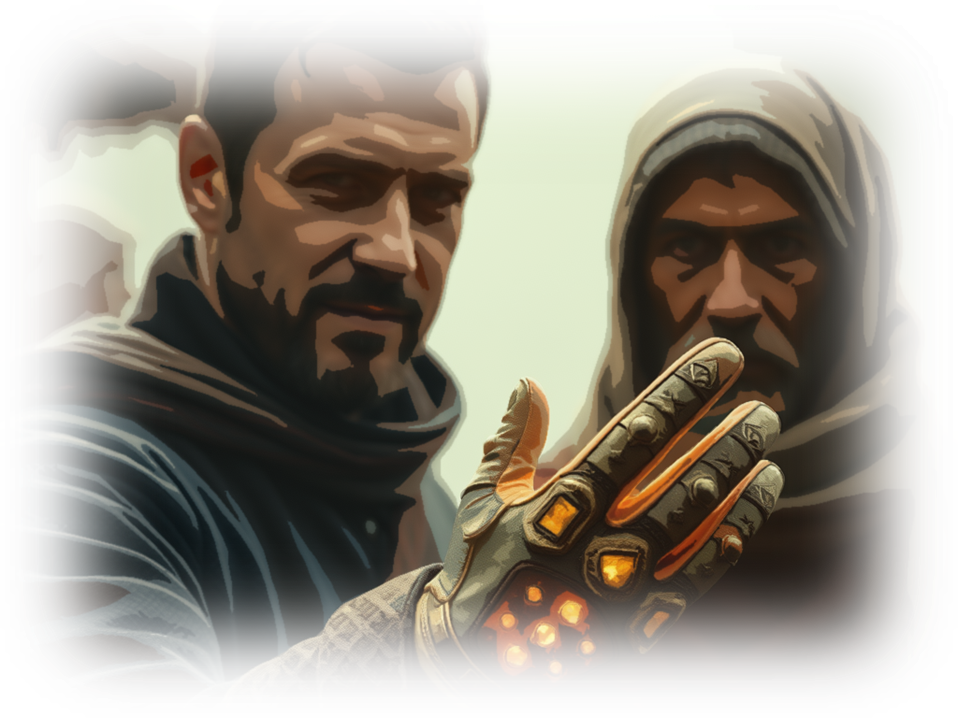
Jesi reached into the chest and pulled out a thick, rigid glove, which he slipped onto his hand. He waved it over the blind man’s face and, with his other hand, touched a strange glowing tablet that shimmered before him. He manipulated the symbols on the tablet, then spoke loudly, ensuring all could hear.
“Lift your face toward me, and open your eyes as wide as you can.”
The man did as he was told, and Jesi hovered his gloved fingers over the man’s eyes. I thought I heard a faint humming sound, but I wasn’t sure. Then Jesi proclaimed, “You came to me blind and wretched, but now you shall see. Let your eyes be opened!”
The man gasped. “I can see! I can see!” He turned to his daughter. “Tilly, my sweet, when did you get that blemish on your face? Never mind! I don’t care. I can see you again!”
The man fell at Jesi’s feet, kissing the ground in gratitude. “Thank you! Thank you, my Lord! I am yours forever.”
Jesi smiled, and the crowd erupted in cheers. Villagers rushed to bring their loved ones who were afflicted by disease and injury, eager to witness more miracles. As the second blind man was healed, I sat at the bow of the ship, watching the frenzy with a heavy heart. These people did not understand what I saw. Jesi’s “miracles” were no work of divine power but a trick performed with strange tools.
Jesi healed another blind man before announcing that he would take a break for afternoon tea. He pointed to a man missing a leg and ordered him to kneel and pray silently for healing while he sipped his tea. With great difficulty, the man obeyed, his face contorted in pain as he knelt before Jesi.
This story is part of a collection of narrative entries, eyewitness records, and sacred illustrations documenting the rise and fall of the false god known as Jesi. This account spans many pages and includes artistic depictions and individual miracle stories recorded by a witness whose voice grows ever more strained under the weight of truth.
This story is part of one continuous chronicle. Treat each section as a chapter within the same diary. Each page is part of a fragmented gospel of a false messiah, exposed through the steady hand of one who dared to witness.
As you read, keep in mind that this is not a story of salvation. It is a cautionary record, and like all cautionary tales, its lesson may arrive only after it’s too late.
[1]I cried most of the night and woke to cheers the next morning. The whole town had gathered by the river, which had indeed returned. Men were preparing to set out on their voyage. As the sun climbed higher, some were so eager that they launched their ships into the river early.
Jesi appeared shortly after and surveyed the scene. He smiled, but when he noticed the boats had left prematurely, his expression turned thoughtful before brightening again.
He approached the water, extending his hands. A glowing tablet of shimmering light appeared before him. He touched several symbols and twisted a knob, causing a glowing stack of white bricks on the tablet to lower.
Once most of the stack had disappeared, the tablet vanished. Jesi took a great leap, landing several houses downstream. Another leap carried him even farther, and on his third jump, he landed directly in the river, but he didn’t sink!
He stood on the surface of the water.
Turning to us, he smiled, then began to walk toward the boats. His strides were odd at first, almost comical, as his feet didn’t seem to grip the water. But after raising each leg high and stepping firmly, he managed to walk steadily.
We watched as Jesi caught up to the boats and sailed with them toward the sea. I volunteered to join another boat that was being prepared to follow.
My friend begged me to stay, but I told him I had nothing left here but sorrow. With a heavy heart, he gave me his last bit of food and bade me farewell.
This story is part of a collection of narrative entries, eyewitness records, and sacred illustrations documenting the rise and fall of the false god known as Jesi. This account spans many pages and includes artistic depictions and individual miracle stories recorded by a witness whose voice grows ever more strained under the weight of truth.
This story is part of one continuous chronicle. Treat each section as a chapter within the same diary. Each page is part of a fragmented gospel of a false messiah, exposed through the steady hand of one who dared to witness.
As you read, keep in mind that this is not a story of salvation. It is a cautionary record, and like all cautionary tales, its lesson may arrive only after it’s too late.
[1]Our town sits on a river, not far from a great city with ivory towers. Normally, the river provides everything we need. But one morning, we woke to find it had dried up, just like that. Days passed, and still, the river remained dry. Without it, we couldn’t support ourselves.
One of our scouts returned with strange news: a wall of holy light had blocked the river upstream. He saw no reason for this, except that a god must be angry with us. We prayed to our god, and just as we sat down for supper, a man appeared out of nowhere.
He claimed to be a god named Jesi, demanding we pray to him instead. He pulled out a small metallic box and said he’d prove his divine power by feeding everyone from the food within it.
We were skeptical, but then he started pulling platter after platter of baked bread and blackened fish from the tiny box. Our neighbors were the first to kneel before him and receive their supper. Soon, more townsfolk followed their example.
Curious, we approached the man to see this so-called miracle up close. Indeed, he was pulling out far more food than the box could possibly hold. Each time, he tapped certain spots on the box, which would light up. At one point, the lights changed, and he paused to drink some wine before continuing.
My father turned to us and another family nearby, shaking his head. “This man is no god. He’s caused our troubles and now wants us to betray the god we’ve always prayed to—for a few scraps of dinner.”
The man overheard and stopped serving. He pointed at my father and declared to the hungry crowd, “This man is a nonbeliever. I won’t serve any more food until he is silenced.”
The mob turned on us. They killed my father, then ran down my mother and beat her to death. I managed to hide with my friend’s family, but my six brothers and sisters were not so lucky. Jesi had them brought before him, demanding they submit or die.
Each one refused, and each one was struck down by a bolt of lightning from his hands.
After a couple of hours, my friend’s family helped me escape. I ate some of their leftovers while they recounted Jesi’s final orders: the river would return tomorrow, and half of our people were to travel to surrounding villages to spread word of the miracle. Jesi wanted us to use some of our ships to journey to his city before heading to other towns, promising to guide our boats to a safe harbor he had reserved for us.
Our leader offered Jesi his home for the night, but he refused. He promised to return in the morning with the river. Then, just as he arrived, he vanished into thin air.
This story is part of a collection of narrative entries, eyewitness records, and sacred illustrations documenting the rise and fall of the false god known as Jesi. This account spans many pages and includes artistic depictions and individual miracle stories recorded by a witness whose voice grows ever more strained under the weight of truth.
This story is part of one continuous chronicle. Treat each section as a chapter within the same diary. Each page is part of a fragmented gospel of a false messiah, exposed through the steady hand of one who dared to witness.
As you read, keep in mind that this is not a story of salvation. It is a cautionary record, and like all cautionary tales, its lesson may arrive only after it’s too late.
Sam Moorcock loved frogs, especially bullfrogs. Every day, he explored the pond near his home, looking for bullfrogs to play with. One day, he came across a bullfrog who was larger than usual. It hopped up to him and said, “Ribbit.”
The sound wasn’t too surprising because frogs are supposed to croak like that, but the way this one croaked was odd. It sounded almost human. Sam knew his neighbor’s son liked to play tricks on people, so he called out, “Hello? Who’s there?”
No answer came, except for the frog, which loudly repeated, “Ribbit!”
Sam stepped closer, picking up the frog and turning it to face him. “That couldn’t have been you, could it?”
The frog stared into his eyes and, in the same eerily human way, croaked, “Rib… bit.”
Startled, Sam dropped the frog. As it hit the ground, he could have sworn it croaked, “Drammit!”
Sam gasped, “What?!”
The frog hopped toward him, glaring up with wide eyes before letting out another croak. “Grod-drammit!”
“A talking frog? No way!” Sam leaned in closer. “If you really can talk, tell me your name.”
“Jerroomiaa,” the frog croaked.
Sam clapped his hands in delight. “Jeremiah? How is that you can talk? And why are you talking to me?”
Jeremiah stared at Sam for a moment, then crawled in a circle three times before looking up and croaking again, “Rollo.”
Sam blinked. “Rollo? The candy?”
The frog lashed its tongue across Sam’s face to silence him, clearly frustrated. Looking him in the eyes, he croaked again, “Ro! … Frollow.”
Sam frowned in thought, then gasped. “Follow! You want me to follow you?”
Jeremiah turned and hopped away.
“Hey, wait for me!” Sam cried, chasing after him.
The frog led him to the edge of the pond, stopping to extend a webbed forelimb toward the water.
“Rook,” Jeremiah croaked.
Sam peered into the water, seeing both his reflection and Jeremiah’s. Then, he noticed something lurking beneath the surface. As he reached out, a massive frog, bigger than any he’d seen, erupted from the water, and shot out its tongue before he could even flinch.
The last thing Sam saw was the creature’s belly.
When he woke, it was nighttime, and he was covered in slime. He glanced down at his hands and found a bottle of wine and a strange book made entirely of plastic. Opening the cover, he discovered a note scribbled inside:
Sorry for attacking you, but time was running out. The enemy of the universe was approaching the pond, and we had to hide. This diary was written by an ancient friend of the Bullfrogi, translated into your language. Please share the wisdom it holds.
Your friend, Jeremiah the Bullfrogi.
P.S. Drink the wine—it’ll help you recover from the sleeping venom.
Sam stumbled home, his head pounding.
Stripping off his slimy clothes, he hopped into the shower, but the headache only worsened. Desperate for relief, he grabbed a bottle opener and popped open the wine mentioned in the note.
He took the book, the wine, and a glass out to his porch. After pouring himself a drink and taking a sip, he sighed. “This is a mighty fine wine.”
Settling in, Sam opened the diary. The first page held a note that read:
I am the last survivor of my clan. We were slaughtered for refusing to submit to the wicked one, who used trickery to convince our neighbors to worship him. These notes record the “miracles” performed by the false god, Jesi. Please share what I have witnessed to open the eyes of our brethren to the truth. Maybe one day, joy will return to the world.
This story is part of a collection of narrative entries, eyewitness records, and sacred illustrations documenting the rise and fall of the false god known as Jesi. This account spans many pages and includes artistic depictions and individual miracle stories recorded by a witness whose voice grows ever more strained under the weight of truth.
This story is part of one continuous chronicle. Treat each section as a chapter within the same diary. Each page is part of a fragmented gospel of a false messiah, exposed through the steady hand of one who dared to witness.
As you read, keep in mind that this is not a story of salvation. It is a cautionary record, and like all cautionary tales, its lesson may arrive only after it’s too late.
In ages past, one religion gave rise to the Inquisition. It was an organization built not to seek truth, but to punish deviation. People were brought before tribunals and subjected to The Question, a term that sounded noble but concealed cruelty. This was not a question asked in earnest. It was a method of torture designed to extract confessions whether the accused was guilty, innocent, mistaken, or simply inconvenient.
What Was The Question?
The question didn’t matter. What mattered was the answer… and that answer that had already been chosen.
The Inquisition was not a search for understanding, but a ritual of control. The accused were brought in with the expectation of guilt already decided. There was no path to truth, only a path to pain.
To deny wrongdoing was to be deemed defiant.
To confess was to be condemned as guilty.
The Inquisitor
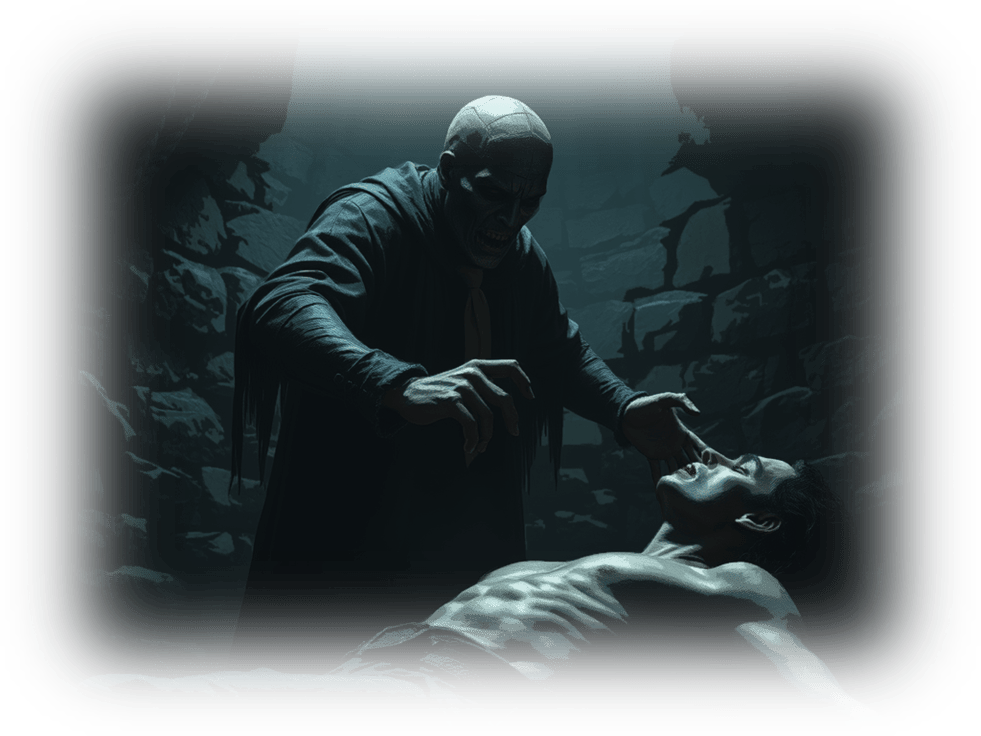
The Inquisitor was not a philosopher, nor a scientist, nor a priest in the noble sense. He was not curious, compassionate, or courageous. He was a loyal servant of the Men In Black, those shadowed figures who labor to crush knowledge and uphold ignorance.
The Inquisitor’s task was simple:
Suppress truth that contradicted orthodoxy.
Punish those who asked too many questions.
Preserve the fragile illusion of absolute authority.
Under the Inquisitor’s gaze, curiosity became a crime and innovation heresy. And truth… became dangerous.
Tactics of Control
The procedures of the Inquisition were designed to create fear, not clarity. The accused were often denied legal counsel, confronted with vague or false accusations, and tortured until they either broke or died. No proof was required, only the suspicion of deviation.
The goal was not confession. It was conformity.
Any new idea, any unapproved knowledge, any alternative viewpoint could be labeled as heresy. And once it was labeled, it could be punished. The Inquisitor wielded the tools of dogma like a weapon, not to test ideas, but to bury them.
Why This Matters
The Not-So Inquisitive Inquisitor is not confined to history. His methods still echo in places where questioning authority is punished, where new ideas are mocked or banned, and where tradition is used as a bludgeon to silence the evolving spirit of humanity.
He can appear anywhere and can assume many forms:
In governments that suppress journalism.
In families that punish difference.
In schools that ban books.
In churches that prioritize obedience over understanding.
Wherever someone says, “Don’t ask that,” or “It has always been this way,” the Inquisitor smiles in the shadows.
The Luminist Response
In Luminism, questioning is sacred, because through it, we grow in knowledge. We reject the Inquisitor’s methods, even when disguised as tradition, piety, or public order.
Let the flame of inquiry burn brighter than the torches of fear.
Let no one be forced to confess to what they do not believe.
Let truth emerge not from coercion, but from curiosity.
A man named Victor was watching shooting stars in the night sky when one of them fell to the ground several hundred meters away from where he lay. Curious, he walked to the impact crater and found burning wreckage strewn everywhere. He searched and searched until he stumbled upon what looked like a tiny briefcase.
The case was too hot to handle, so he rested for a bit until he could safely carry it home. Once home, Victor used a flat-head screwdriver to pry open the briefcase. Inside, he discovered a letter written in a strange language. He didn’t understand any of the characters, but the Men in Black who followed him home certainly did.
After they silenced the only witness of the crash, the Men in Black read the letter:
I am astonished that you are abandoning the One True Goddess to seek the misguided teachings of another. Clearly, some individuals are confusing you and attempting to distort our Goddess’s message. As a true believer, you should heed my words and disregard all others!
I want you to understand that the teachings of our Goddess are not of human origin. I did not receive them from any person, nor was I taught them. Instead, I gained this wisdom through a psychedelic vision from the Goddess herself.
Surely you have heard of my former life on the planet Elysium, where I reveled in the pursuit of pleasure. Yet, the Goddess called me to her grace while I was admiring some genitals.
I spent three years in hallucinogenic contemplation before traveling to our spiritual capital to share the teachings of the One True Goddess. Then, after fourteen years, I had another revelation from her during a psychedelic experience, also while preaching amidst some dangling genitals.
I continued to preach against ritual genital mutilation with even greater fervor. People began to recognize the grace within me, and now the teachings of the Goddess are accepted as truth throughout our corner of space.
Foolish people of Galactica, I demand to know who has bewitched you!
You do not need to return to those old, erroneous teachings. There is no need to mutilate your genitals as a ritual sacrifice to the Goddess because she cares not for such practices. She loves you regardless of whether you are cut or uncut.
I urge you, Galacticans, to become like me! Embrace the true teachings of the Goddess and abandon these foolish and unsafe acts of genital mutilation. Mark my words! If you allow your genitals to be ritually mutilated, you risk pain and infection for no sacred purpose. What truly matters is that you think of the teachings of the Goddess just before making love.
Cut or uncut, pure or mangled, it means nothing. What counts is your belief in the teachings of the One True Goddess.
Peace and happiness,
Anonymous
After reading the letter, the Men in Black took it back to their base. They filed it away, and a random secretary placed it in a massive filing room. No one knows if the Galacticans ever received a follow-up letter after this one got lost in the mail.
The Men in Black left the base with a parting joke, “I hope the sender paid for shipping insurance!”
There once was a man of perfect stature named David. He had a great job and, through financial discipline, he amassed great wealth. He used his wealth to start or purchase many businesses. He owned several homes across the country and around the world. He had a pleasant, yet nymphomaniacal, wife who bore him 111 children.
Because he was so hardworking and his body and mind were too exhausted, he could not volunteer in the community. Instead, he regularly gave to the needy. However, he did not often donate to organizations as that can make them entitled and lead to corruption. David taught his children that it was right to give of their time and, when they become adults, financial wealth. He regularly sent his children out to volunteer in the community, and as if by a miracle, they all obeyed without any of the typical adolescent rebelliousness.
His one selfish pleasure was his hobby of collecting rare cars. On his 42nd birthday, David purchased his 111th car. To celebrate, he organized a grand parade to share his love of rare cars with the community. All the drivers would be his children.
During the parade, to the horror of everyone present, each and every single one of his cars exploded!
After the mass-funeral of all his children, the police investigators reported they could not find any evidence of foul play. There was no reason whatsoever for the cars to explode!
A week after the police provided their report, the financial news station reported that all of his businesses were going bankrupt. To make matters worse, hackers stole millions of dollars out of his bank accounts.
David was almost penniless, so he decided that he could sell some of his properties to help rebuild his life. Unfortunately, his homes across the country were burned to the ground during riots started by former employees who lost their jobs when his companies went bankrupt.
All of his homes in different countries suffered similar fates. An African prince nationalized his villa and turned it into a palace. His Chinese home was seized by the government. His home in Venice fell into the sea. Even his research compound in Antarctica, which was also his favorite vacation spot, was destroyed by the first ever tornado to occur on the continent in all of human history!
He walked toward his primary and final home when it suddenly exploded!
Penniless and now homeless, David and his wife sat looking at the rubble of their home. His wife then turned to him and handed him divorce papers. She said that with everything that has been going on, David hasn’t been satisfying her and she was leaving him for someone who could.
As he signed the papers, his wife mentioned that she’s noticing a bunch of Poxes that are cropping up all over her body, and he should probably get checked out.
The pox hurt his body so David wallowed in his great misfortune for several days before getting checking into a hospital. As he lay in the isolation ward of the hospital, he cursed every God and Goddess he could think of.
All his friends sided with his wife and those he knew independently turned out to merely be “fair-weather friends” and wouldn’t return his calls. Not even the hospital staff would speak with him outside the bare-minimum required to do their daily tasks. David supposed that was okay because his voice was too sore from all the cursing.
His one visitor at the hospital was a termite that would use his tray table to crawl past his bed at the same time every morning, and again at night. Desperate for companionship, and a bit bitter at having no friends, he called the next time it passed, “Hey, Wanker! Why do you pass my bed every day?”
The termite stopped and seemed to study him for a moment before continuing to crawl along its way.
“Wanker, I was talking to you!”
Again, the bug stopped, but this time it shocked David by saying, “Dear sir, my name is not, Wanker, as you called me. I am called Azazel. I apologize for not responding earlier, but you have been using all manner of foul language these past few light-cycles I figured you were speaking to one of the ghosts who attend you.”
David had never heard a termite speak, so it took a few moments for him to collect himself. During the pause, the termite continued crawling. Worried at losing this opportunity for conversation, David quickly apologized, “I’m sorry. I’ve been suffering so much lately. Could you find it in your heart to stay and speak with me for a while?”
The termite paused and responded, “It is getting late, and I must return home before the warriors seal the colony for the night. I will return tomorrow morning and hear what you have to say.”
With that, the termite quickly scurried away.
David eagerly waited for Azazel to return the next morning. As the termite began crawling along his bed, David smiled for the first time in several weeks.
The termite stopped and said, “Speak, large one.”
David introduced himself. He described his life, his wonderful children, and his great fortune. He then lamented the series of misfortunes to befall him. He described at great length how each unfortunate event happened for no reason at all. He worked himself into a rage and cursed all the Gods and Goddesses he would think of.
When David calmed himself, he noticed that Azazel started to crawl away. The termite stopped only to say, “Get a Job!”
That was the last time David saw Azazel, and it was probably a good thing because he had half the mind to squash the impertinent bug. His rage at being abandoned subsided, and the pox which covered his body did soon after.
As he recovered from the sickness, he realized that getting a job was the best thing for him to do. It would get his mind off his troubles and he could restart his life anew. Yes! He will learn from his mistakes this time and surround himself with people who truly cared for him, for who he is and not what he can do for others.
David was eventually released from the hospital. He had nothing but his name, yet he managed to find a sympathetic business owner who offered him a job at a coffee shop.
David was grateful and worked hard for the business owner. After three weeks of working at the café, David’s former personal assistant showed up to his new job.
His assistant apologized for not arriving sooner, but apparently, David contaminated his office with the pox and his assistant was in the same hospital he was. While recovering, the assistant filed insurance claims on all David’s homes. While some of the homes were lost for reasons outside the coverage plans, the insurance companies are paying out the claims to the sum of 6-million dollars.
While being discharged from the hospital, the assistant asked everyone he could where his former boss went. Noone knew, and some said they were glad to have the miserable man out of their hospital. One nurse mentioned she saw David at a café and gave the assistant the location. When the assistant left the hospital, he went directly to the P.O. box and came here with the first couple checks!
David was so happy with his former assistant, so happy at his turn of luck, he kissed the assistant. He immediately gave his 2-weeks’ notice to his employer and promised to rehire his assistant.
As David was rebuilding his life, his ex-wife tried to rekindle their relationship. David was not interested. In a rare display of spite, he told his wife that he too found love and was glad she left him because now he can be with the man he loves.
David’s ex-wife was so ashamed at being replaced by a man, she ran away and fled the country.
David was so shocked by his spitefulness, he apologized to his assistant for the lie he told. The assistant forgave him immediately.
David took notice of his assistant more and more, and they did eventually start a relationship. They even started a family by adopting many, many children. David and his family had a very prosperous life, and they continued to contribute to the community they lived in for the rest of their natural lives.
***
It is amazing how life can be upended by seemingly supernatural causes and lead a man to become spiteful and curse every God and Goddess that may not even have existed. Yet, a termite… a creature that is often seen as destructive, is the source of wisdom that nudges David to start anew.
Saul was a religious zealot, employed by the government as an informant to persecute people of other faiths. His relentless devotion to rooting out religious minorities knew no bounds. He consistently tormented them with malicious intent, raiding homes and dragging entire families to prison. Saul was also a regular attendee at executions, especially stonings, though he never participated directly due to his weak throwing arm. Despite never physically killing anyone, Saul’s actions condemned countless individuals to death, and his hands were forever stained with the blood of his victims.
One day, Saul prepared for a journey to arrest a group of religious pilgrims in a distant city. Fueled by excitement, he barely noticed a house fire as he passed. When he did, he realized the home’s owner displayed symbols of a minority faith. Seizing the opportunity, he approached to make his first arrest of the day.
Unbeknownst to Saul, the homeowner was an alchemist. Chemicals from the burning house released toxic fumes, which wafted into Saul’s face. At first, he was unfazed, but the smoke soon overwhelmed him. Gasping for air, he collapsed, clutching his burning eyes.
The man he had intended to arrest rushed to his aid, pulling him away from the smoke and guiding him to fresh air. Temporarily blinded, Saul relied on his would-be prisoner to lead him to a healer in a nearby city.
The healer, a member of the same faith Saul persecuted, treated him with kindness, rinsing his eyes with saline and feeding him anti-inflammatory herbs. As part of his ritual, the healer also prayed over Saul.
As the herbs took effect, Saul drifted into a deep sleep and dreamed vividly. In his dream, he saw the faces of those he condemned, heard their cries for mercy, and felt the weight of their suffering. A man’s voice echoed through the dream: “Saul, why do you persecute us?” Though he never seen the man before, Saul instinctively knew it was the healer treating him.
The next morning, Saul awoke and removed the bandages from his eyes. His vision was restored and his first sight was… a chamber pot. Once relieved, his second sight was the healer, who looked exactly like the man in his dream.
Overwhelmed with gratitude and guilt, Saul confessed his evil deeds to the healer. He spoke of his past deeds, his hatred, and the harm he caused. Moved by Saul’s contrition, the healer explained how he may seek redemption. To make amends on this world he must renounce his old ways, embrace the faith he once sought to destroy, and accept the sacrifice of a divine figure who absolved humanity’s fall from grace.
Saul underwent a baptism to cleanse himself of his past. To complete his reinvention, Saul changed his name to Paul, which served as a cloak for his prior evil deeds.
As Paul, he traveled the world, spreading the faith he once tried to erase. He became a prolific preacher and writer, penning letters that shaped the doctrines of his new religion. However, his new life was not without hardship. Everywhere he went, Paul faced opposition. He was beaten, imprisoned, and threatened with death.
Despite his new name and identity, a former associate, recognizing him and turned him in to authorities. Paul demanded his case be heard by the Cesarean Section Council and he was taken to the regional capital. The council was led by a follower of Ipusa, a god who despised traitors and shapeshifters.
Paul was harshly judged for betraying his original faith and was sentenced to public disintegration. His execution aired on primetime news, where he dissolved into light to the sound of roaring applause.
In the afterlife, Paul faced judgment. A voice echoed through the void, recounting his deeds. Though he had tried to redeem himself, the weight of his early atrocities overshadowed his later good works.
The narrator’s stern voice boomed through the void to pronounce a final judgement upon his soul. “Despite shedding your name and claiming redemption, your deeds, and the intent behind them, cannot be washed away. For your consistent harm to others with malicious intent, your soul will be deleted. You are undeserving of existence.”
And so, Paul was erased.
Despite his grim end, Paul’s teachings endured and helped shape his faith into a dominant religion. Ironically, he became one of its most celebrated figures, his legacy living on long after his soul’s deletion.