
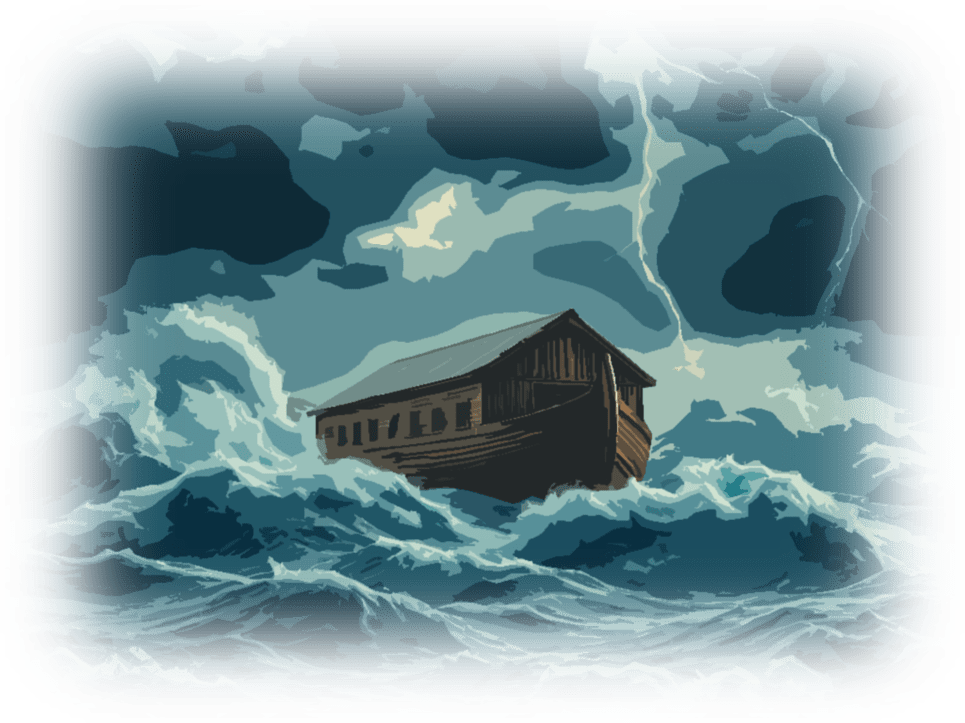
Long ago, a so-called god looked upon the world and didn’t like what he saw.
There were many animals, both gentle and fierce. There were majestic unicorns, a handful of dinosaurs, a subterranean civilization of Pomeranians, and another of reptilian scholars. Above all, there were free-thinking humans.
This god, however, had plans for the land. He viewed these creatures, especially the independent-minded humans, as potential interlopers. Worse, they weren’t groveling or offering sacrifices. They weren’t even afraid.
This would not do.
So, the god resolved to wipe them out. Most of them, anyway.
He found one man he liked, and decided to spare him and his family. He was not chosen for his wisdom or virtue, but for his blind obedience.
The god instructed this man to build a massive ship, an “ark,” to preserve a sample of life… specifically, the parts the he approved of. The man obeyed, but had no experience in shipbuilding and what he built resembled a soggy raft.
This would not do either.
So, the god secretly dispatched robotic servants to complete the project and, while he was at it, installed dimensional tech to make the interior larger than it appeared. This ensured the vessel was spacious enough to house all the creatures the god intended to save.
He commanded the man to gather two of every species. For the dangerous or evasive ones, he gave him tranquilizer gear and simple stasis tools. But the man, ever clueless, overdosed several animals… killing them outright. Replacements had to be sourced, and eventually, one of his more competent daughters was reassigned to the task.
Later, it was discovered that the man never checked the sex of the animals. He brought pairs to the ship, but some were both male or both female.
Meanwhile, the god unleashed his plan:
- He triggered unceasing rain through weather control devices.
- He redirected rivers using terraforming tools.
- He activated a gravity well generator that was hovering in low orbit to hold the floodwaters in place.
The twin cities of the reptilians drowned beneath the tides. And his robotic servants hunted the survivors down as they fled to the surface.
The subterranean Pomeranians fared no better. The god shattered the land bridge holding back the Atlantic Ocean and water crashed through ancient tunnels to bury their basin cities in brine.
And the humans?
For nearly two months, the land was submerged. Just long enough to wipe out the undesirables, and to leave a lingering threat for the survivors. He didn’t kill all of them, just the ones who lived in the region he coveted. The rest, far from the flood zone, were spared purely by accident.
When the rain finally ceased, a rainbow arced across the sky. The god claimed credit for this natural phenomenon and declared it a sign. Not a promise of peace, but a veiled threat: “Next time, it’ll be fire.”
When the ark finally landed, the god inspected the preserved animals and discovered the problem.
Two male unicorns grazed beside the ramp.
He glared at the man. “Did you even check the genders?”
The family suddenly found the nearby rocks very interesting. Alone, the man stammered, “No, uh…”
The god grumbled, suppressing his anger. The man was, after all, loyal. Gullible, yes… but most importantly, loyal. So, he was assigned the task of catalog each animal and mark which pairings were unusable.
Thankfully, the error rate was low.
More curious, though, was the fate of the Spectrumgobblus or Rainbow-Colored Turkey. Records showed two had boarded the ark, but only one remained.
The god narrowed his eyes.
He remembered briefly inspecting the family mid-voyage. He saw a rather large roasted bird on the dinner table, but…
…surely, they didn’t?
Did they?
Reflection
The flood myth is a cautionary tale that serves to highlight something deeply troubling about the types of deities humans have historically chosen to worship. Most are all-powerful, demanding of loyalty, and wrathful at disobedience. All while exhibiting petulance and indifference to the cruelty done to others.
In Luminism, we ask:
- What kind of god needs to kill to teach a lesson?
- What kind of wisdom is proven through genocide?
- And what kind of people call that holy?
This story forces us to confront the reality that morality cannot simply be what a powerful being commands. Obedience is not inherently good. In fact, blind obedience to unjust authority is often the mechanism by which great evil is carried out.
In the end, this isn’t a story about salvation. It’s a story about selective survival, enforced conformity, and the kind of god who mistakes domination for righteousness.
If your god demands the death of others to prove his glory, he may not be worth following.


Leave a Reply