Luminism is a modern philosophy and religion of reason, compassion, and moral clarity. It teaches that goodness stands on its own… not on dogma, not on fear, and never on threat of divine punishment.
[1] I lived for several hundred years, traveling across the world. I’ve wandered through vast deserts and scaled many mountain ranges. I visited lands where the people’s eyes are long and narrow, and from there, I bid farewell to the Han and journeyed into a realm of endless winter. For a long time, I regretted entering this desolate land, but eventually, I emerged into a wide expanse of plains.
In this region, I encountered people with long hair, broad noses, and deep-set eyes. They were kind, guiding me southward through dense jungles. I wandered through these jungles until I reached the southernmost tip of the world. After many years, I returned to the great plains, deciding that my travels had been enough.
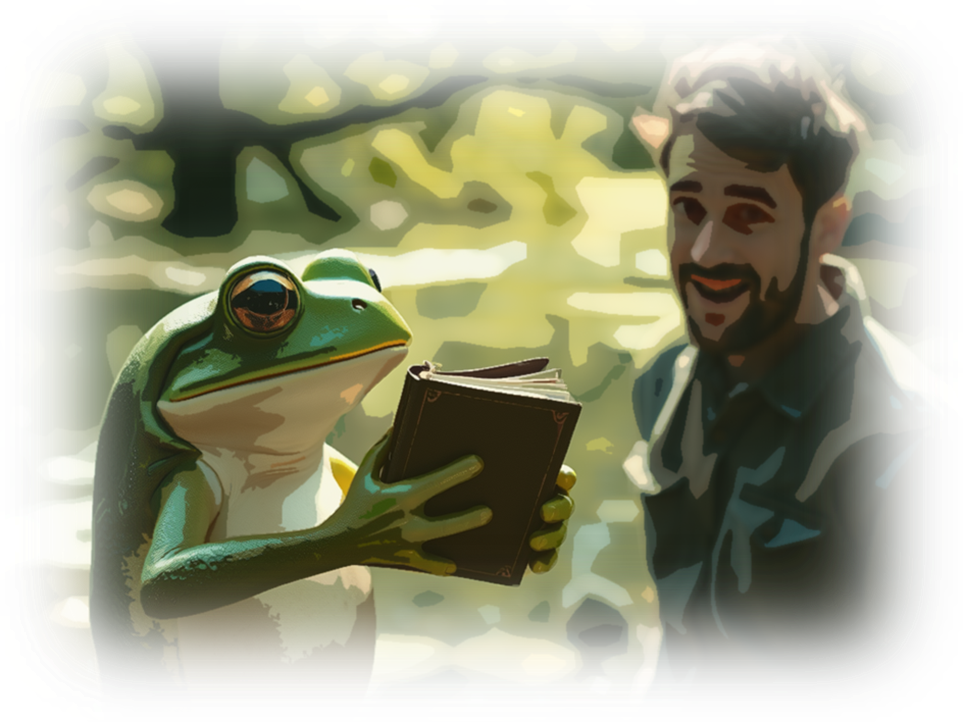
I asked a local tribe if I could build a home, and they led me to land that belonged to no one. It was there that I met the Bullfrogi. Beneath the surface world, they had built a remarkable civilization, and from them, I learned much about the heavens and the stars.
The Bullfrogi spoke of a spacefaring civilization known as the Federation. However, when I shared my diary, recounting my experiences with Jesi, they grew anxious. They explained that Jesi had been influenced by a great enemy of the universe… the men who always wear black.
Now, I am old and weary. I entrust this diary to the Bullfrogi, for they have promised to protect its knowledge and share it with my people when the time is right.
I don’t know you, dear reader, but I beg you to share what I have recorded here. Do not let humanity fall once again into religious slavery, deceived by false gods. We did not understand before that other beings exist in the universe who wield tools of unimaginable power and possess superior biological abilities.
We can become like them, but only if we open our eyes to the truth.
This story is part of a collection of narrative entries, eyewitness records, and sacred illustrations documenting the rise and fall of the false god known as Jesi. This account spans many pages and includes artistic depictions and individual miracle stories recorded by a witness whose voice grows ever more strained under the weight of truth.
This story is part of one continuous chronicle. Treat each section as a chapter within the same diary. Each page is part of a fragmented gospel of a false messiah, exposed through the steady hand of one who dared to witness.
As you read, keep in mind that this is not a story of salvation. It is a cautionary record, and like all cautionary tales, its lesson may arrive only after it’s too late.
[1]We sailed into a Roman-controlled harbor, and the moment we docked, a soldier approached Jesi. He saluted him with the raised-arm gesture typical of the Romans and addressed him as “My lord,” though there was no reverence in his voice. It struck me that the Romans seemed to worship something greater than their gods. They worshipped the immortal city of Rome itself, and their empire. And yet, Jesi seemed perfectly content with this arrangement. Perhaps with the most powerful political entity in the world, it was obedience that mattered more than worship. Or maybe, they were simply too vast to control.
Or was it that Jesi was just starting out, using us to spread his influence? We were planting the seeds of his miracles in the minds of all who listened, and he would later reap the worship of his adoring followers. Each city we visited was a stepping stone in his plan, each miracle performed a carefully laid piece of his design. One day, when the seeds had taken root, they would blossom into unquestioning devotion. We were only the beginning.
Jesi commanded some men to bring a palanquin for the journey into the city. As we waited, he informed us he intended to preach and heal the sick. The city was several miles inland, and he desired to meditate during the trek. We drew lots to see who would carry him. Four men were chosen, all eager to serve, but Jesi quickly dismissed one. The man was too short, Jesi explained, and would make the ride uneven. He sent the man ahead to announce the arrival of a living god.
Then, with his eyes closed, Jesi raised a hand and randomly pointed in my direction. When he opened his eyes, his finger was aimed squarely at me. But just as my hands instinctively moved toward my ears, his lips curled into a smirk, and his finger circled to the man beside me. “You will do,” Jesi said. His voice boomed in my mind without a single word spoken aloud: I cannot afford to have my chronicler exhausting himself when there are miracles to record.
With Jesi aboard the palanquin, we made our way toward the city. About halfway there, I could hear soft snores coming from within. They continued until the walls of the city loomed ahead. As we passed through the gate, Jesi ordered us to the central square.
A fruit vendor caught his eye, and Jesi handed him a coin in exchange for several apples and a cup of juice. He ate as we moved through the crowded streets, tossing cores to the ground where the beggars and street urchins snatched them up. The cup was discarded too, and it intrigued me. It was thin, lumpy, and oddly shaped, unlike any drinking vessel I had seen before.
When we arrived in the square, Jesi stepped from his palanquin to greet the crowd that had gathered, undoubtedly alerted by the short man he had sent ahead. I briefly wondered where the dwarf was while Jesi stepped toward a platform to speak to the gathered crowd.
There, upon the platform, he declared himself the god Jesi and instructed the people to build a temple in his honor. They were to renounce their gods and worship him alone. The whispers from the crowd were hushed, but noticeable. Jesi’s voice grew louder as he invited the crowd to witness his miracles and asked who among them would be first to receive his blessing.
An old woman approached, trembling on her knees as she begged for relief from her aching bones. The village man accompanying us brought Jesi’s chest of tools, and I watched as Jesi repeated his miracle from the previous day, using the same grey powder. He inserted it into a strange needle and, with a broad smile, warned the woman of a slight pain. She flinched as the needle pierced her, but he promised she would feel renewed by morning. She bowed and scurried off into the crowd.
It was then that I noticed something odd. A group of hooded figures, too neatly arranged compared to the masses. Jesi, too, must have sensed something was amiss. Before I could react, Jesi’s body glowed faintly, and he turned toward the group with fury on his face. He drew his wand-like device, and in an instant, bolts of lightning erupted from its tip. The hooded figures threw off their cloaks to reveal weapons as they charged, but it was too late. The lightning struck them down where they stood, their bodies crumpling to the ground one by one.
A spear flew through the air, aimed perfectly at Jesi. But it merely glanced off the shimmering aura that surrounded him, falling harmlessly to the ground. In mere moments, the square was littered with bodies. Jesi climbed back into his palanquin and ordered us to surround him as we fled the city. His command was clear: “Have faith, and no harm will come to you.”
As we hurried through the streets, a lone guard stepped forward to block our way, but Jesi’s wand flashed again, and the man collapsed before even raising his weapon. We passed through the gate unscathed, arrows fired in our direction bouncing harmlessly off an invisible shield that Jesi had raised. It was not until we had run for nearly a mile that he ordered us to stop and rest.
Jesi pulled out the metallic box he used to conjure food and drink. He distributed liquid among us, filling our cups with a sweet, salty, and faintly alcoholic beverage. He toasted to our coming victory, claiming that we few would lay siege to the city and that its walls would crumble before us. His confidence was unsettling. As I sipped the green liquid, I could feel its effects immediately, refreshing my body but doing little to calm my mind.
Jesi spoke of setting up camp and preparing for the morrow. As I sat by the fire, recording the events in my diary, the weight of the day’s events settled heavily on me. Despite the display of power, the deaths of those men were a stark reminder: no matter how much I despise Jesi, I must never act against him directly. For he may not be a god, but he wields abilities far beyond anything I could ever hope to challenge.
I peeked at Jesi’s transport and saw two eyes peering back from within.
This story is part of a collection of narrative entries, eyewitness records, and sacred illustrations documenting the rise and fall of the false god known as Jesi. This account spans many pages and includes artistic depictions and individual miracle stories recorded by a witness whose voice grows ever more strained under the weight of truth.
This story is part of one continuous chronicle. Treat each section as a chapter within the same diary. Each page is part of a fragmented gospel of a false messiah, exposed through the steady hand of one who dared to witness.
As you read, keep in mind that this is not a story of salvation. It is a cautionary record, and like all cautionary tales, its lesson may arrive only after it’s too late.
Long ago, in the age of stardust cities and crystal-lit skies, there lived a proud and orderly people known as the Licali. They were dignified, deeply spiritual, and united by a moral code older than memory. They believed purity of action preserved the soul, and that impurity invited divine punishment.
One day, a strange illness began to spread.
It started quietly. A cough here, and a weakness there. But with each passing day, it moved faster, burning through the population like wildfire.
Some cried out for help, while others whispered fears of infection. But the priests and elders of the Licali refused to listen.
“It is not a disease,” they declared.
“It is a curse, brought on by shameful behavior and impurity. If you are sick, it is because your heart is corrupt.”
Fearful of judgment, the sick hid their symptoms. Families of the sick shunned and kept the illness a secret to avoid disgrace. And neighbors looked away, ignoring the signs they didn’t wish to see.
As more people fell ill, the whispers grew, but so did the denial.
“Cleanse your thoughts,” said the elders.
“Pray harder,” said the priests.
“Be silent,” said those in charge. “Or else the curse will consume you all.”
But it was the silence that consumed them. By the time the truth could no longer be ignored, it was too late.
The Licali were already lost.
Their cities stood empty.
Their temples fell quiet.
No enemy had lifted a weapon.
No god had cast a bolt of judgment.
The “curse” was real, but it was not divine. It was something older, planted long ago by an unseen hand. A forgotten war had left behind a hidden, slow poison, a whisper of death that fed on pride and denial.
The Licali did not perish because of immorality. They perished because they were taught to fear truth more than lies.
Reflection
Never let pride, denial, or superstition silence those in need, when science and compassion could save them. No illness should be labeled as divine judgment. Nor should suffering be dismissed as deserved.
The truth must be welcomed, even when it frightens us.
There once was a man of perfect stature named David. He had a great job and, through financial discipline, he amassed great wealth. He used his wealth to start or purchase many businesses. He owned several homes across the country and around the world. He had a pleasant, yet nymphomaniacal, wife who bore him 111 children.
Because he was so hardworking and his body and mind were too exhausted, he could not volunteer in the community. Instead, he regularly gave to the needy. However, he did not often donate to organizations as that can make them entitled and lead to corruption. David taught his children that it was right to give of their time and, when they become adults, financial wealth. He regularly sent his children out to volunteer in the community, and as if by a miracle, they all obeyed without any of the typical adolescent rebelliousness.
His one selfish pleasure was his hobby of collecting rare cars. On his 42nd birthday, David purchased his 111th car. To celebrate, he organized a grand parade to share his love of rare cars with the community. All the drivers would be his children.
During the parade, to the horror of everyone present, each and every single one of his cars exploded!
After the mass-funeral of all his children, the police investigators reported they could not find any evidence of foul play. There was no reason whatsoever for the cars to explode!
A week after the police provided their report, the financial news station reported that all of his businesses were going bankrupt. To make matters worse, hackers stole millions of dollars out of his bank accounts.
David was almost penniless, so he decided that he could sell some of his properties to help rebuild his life. Unfortunately, his homes across the country were burned to the ground during riots started by former employees who lost their jobs when his companies went bankrupt.
All of his homes in different countries suffered similar fates. An African prince nationalized his villa and turned it into a palace. His Chinese home was seized by the government. His home in Venice fell into the sea. Even his research compound in Antarctica, which was also his favorite vacation spot, was destroyed by the first ever tornado to occur on the continent in all of human history!
He walked toward his primary and final home when it suddenly exploded!
Penniless and now homeless, David and his wife sat looking at the rubble of their home. His wife then turned to him and handed him divorce papers. She said that with everything that has been going on, David hasn’t been satisfying her and she was leaving him for someone who could.
As he signed the papers, his wife mentioned that she’s noticing a bunch of Poxes that are cropping up all over her body, and he should probably get checked out.
The pox hurt his body so David wallowed in his great misfortune for several days before getting checking into a hospital. As he lay in the isolation ward of the hospital, he cursed every God and Goddess he could think of.
All his friends sided with his wife and those he knew independently turned out to merely be “fair-weather friends” and wouldn’t return his calls. Not even the hospital staff would speak with him outside the bare-minimum required to do their daily tasks. David supposed that was okay because his voice was too sore from all the cursing.
His one visitor at the hospital was a termite that would use his tray table to crawl past his bed at the same time every morning, and again at night. Desperate for companionship, and a bit bitter at having no friends, he called the next time it passed, “Hey, Wanker! Why do you pass my bed every day?”
The termite stopped and seemed to study him for a moment before continuing to crawl along its way.
“Wanker, I was talking to you!”
Again, the bug stopped, but this time it shocked David by saying, “Dear sir, my name is not, Wanker, as you called me. I am called Azazel. I apologize for not responding earlier, but you have been using all manner of foul language these past few light-cycles I figured you were speaking to one of the ghosts who attend you.”
David had never heard a termite speak, so it took a few moments for him to collect himself. During the pause, the termite continued crawling. Worried at losing this opportunity for conversation, David quickly apologized, “I’m sorry. I’ve been suffering so much lately. Could you find it in your heart to stay and speak with me for a while?”
The termite paused and responded, “It is getting late, and I must return home before the warriors seal the colony for the night. I will return tomorrow morning and hear what you have to say.”
With that, the termite quickly scurried away.
David eagerly waited for Azazel to return the next morning. As the termite began crawling along his bed, David smiled for the first time in several weeks.
The termite stopped and said, “Speak, large one.”
David introduced himself. He described his life, his wonderful children, and his great fortune. He then lamented the series of misfortunes to befall him. He described at great length how each unfortunate event happened for no reason at all. He worked himself into a rage and cursed all the Gods and Goddesses he would think of.
When David calmed himself, he noticed that Azazel started to crawl away. The termite stopped only to say, “Get a Job!”
That was the last time David saw Azazel, and it was probably a good thing because he had half the mind to squash the impertinent bug. His rage at being abandoned subsided, and the pox which covered his body did soon after.
As he recovered from the sickness, he realized that getting a job was the best thing for him to do. It would get his mind off his troubles and he could restart his life anew. Yes! He will learn from his mistakes this time and surround himself with people who truly cared for him, for who he is and not what he can do for others.
David was eventually released from the hospital. He had nothing but his name, yet he managed to find a sympathetic business owner who offered him a job at a coffee shop.
David was grateful and worked hard for the business owner. After three weeks of working at the café, David’s former personal assistant showed up to his new job.
His assistant apologized for not arriving sooner, but apparently, David contaminated his office with the pox and his assistant was in the same hospital he was. While recovering, the assistant filed insurance claims on all David’s homes. While some of the homes were lost for reasons outside the coverage plans, the insurance companies are paying out the claims to the sum of 6-million dollars.
While being discharged from the hospital, the assistant asked everyone he could where his former boss went. Noone knew, and some said they were glad to have the miserable man out of their hospital. One nurse mentioned she saw David at a café and gave the assistant the location. When the assistant left the hospital, he went directly to the P.O. box and came here with the first couple checks!
David was so happy with his former assistant, so happy at his turn of luck, he kissed the assistant. He immediately gave his 2-weeks’ notice to his employer and promised to rehire his assistant.
As David was rebuilding his life, his ex-wife tried to rekindle their relationship. David was not interested. In a rare display of spite, he told his wife that he too found love and was glad she left him because now he can be with the man he loves.
David’s ex-wife was so ashamed at being replaced by a man, she ran away and fled the country.
David was so shocked by his spitefulness, he apologized to his assistant for the lie he told. The assistant forgave him immediately.
David took notice of his assistant more and more, and they did eventually start a relationship. They even started a family by adopting many, many children. David and his family had a very prosperous life, and they continued to contribute to the community they lived in for the rest of their natural lives.
***
It is amazing how life can be upended by seemingly supernatural causes and lead a man to become spiteful and curse every God and Goddess that may not even have existed. Yet, a termite… a creature that is often seen as destructive, is the source of wisdom that nudges David to start anew.
In a small, dusty desert town lived a virgin named Mitzi, daughter of a proud sheep herder. Her father took great pride in his flock, until the day one of his sheep gave birth to a deformed lamb.
It was completely bald.
A hairless lamb was useless to a herder, and worse, it was seen as a bad omen. The villagers believed such deformities were signs that the village god was angry, and that his curse had fallen upon the family.
Fearing what the others might say, Mitzi’s father prepared to kill the lamb. But Mitzi felt something unusual in the creature, something rare and precious.
She begged her father to spare it.
He refused at first. But she pleaded so desperately that he relented, on one condition: the lamb must never be seen by anyone.
Not even him.
Mitzi agreed and raised the lamb in secret. Time passed, and one day, the lamb grew golden fleece. Overcome with pride, she paraded the lamb through the village.
The townspeople were amazed by the sight of a lamb with shining golden fleece, and they began to sing in celebration:
“Mitzi had a little lamb, its fleece was golden so. Everywhere that Mitzi went, the lamb was sure to go.”
Even her father, who had once cursed the lamb’s birth, was astonished. The deformed creature had become a miracle. But the miracle came with a price.
The village god was a man.
He was a man with advanced technology and machines that the people mistook for divine power. From time to time, he visited the town to remind the villagers of his presence. On his last visit, he had experimented on her father’s flock.
When he heard news of the unusual lamb, he returned to the village to see it himself. The experiment had worked!
The lamb was of interest to him, but it was Mitzi who captured his attention. He was mesmerized by her beauty, and he decided he must have her.
He sent a mechanical “bee” to sting her, rendering her unconscious. Then he took her to his remote outpost, where he violated her sleeping body. When he was finished, he returned the sleeping beauty to her home.
Mitzi never knew what had been done to her… until her belly began to swell with new life.
News of the virgin pregnancy soon reached the village god. He cared nothing for the child. The hybrid was inferior in his eyes, unworthy of his time. But he feared that allowing a “divine” child to be abandoned would set a dangerous precedent. And so, he sent one of his assistants to deliver a message to Mitzi.
The messenger was a woman, disinterested and unenthusiastic about being sent on such a mundane task. She appeared before Mitzi, pointed at her growing belly, and spoke:
“I just met you, and this is crazy, but God just raped you… go have his baby. It’s hard to look right at you, lady, so please remember, don’t kill his baby.”
And with that, she left.
Mitzi did as she was told. She raised the child alone.
The villagers worshipped the baby, calling him the son of a god. But he grew up to be nothing remarkable. He performed no miracles, offered no revelations. His only divine trait was the story of his birth.
Long ago, a so-called god looked upon the world and didn’t like what he saw.
There were many animals, both gentle and fierce. There were majestic unicorns, a handful of dinosaurs, a subterranean civilization of Pomeranians, and another of reptilian scholars. Above all, there were free-thinking humans.
This god, however, had plans for the land. He viewed these creatures, especially the independent-minded humans, as potential interlopers. Worse, they weren’t groveling or offering sacrifices. They weren’t even afraid.
This would not do.
So, the god resolved to wipe them out. Most of them, anyway.
He found one man he liked, and decided to spare him and his family. He was not chosen for his wisdom or virtue, but for his blind obedience.
The god instructed this man to build a massive ship, an “ark,” to preserve a sample of life… specifically, the parts the he approved of. The man obeyed, but had no experience in shipbuilding and what he built resembled a soggy raft.
This would not do either.
So, the god secretly dispatched robotic servants to complete the project and, while he was at it, installed dimensional tech to make the interior larger than it appeared. This ensured the vessel was spacious enough to house all the creatures the god intended to save.
He commanded the man to gather two of every species. For the dangerous or evasive ones, he gave him tranquilizer gear and simple stasis tools. But the man, ever clueless, overdosed several animals… killing them outright. Replacements had to be sourced, and eventually, one of his more competent daughters was reassigned to the task.
Later, it was discovered that the man never checked the sex of the animals. He brought pairs to the ship, but some were both male or both female.
Meanwhile, the god unleashed his plan:
He triggered unceasing rain through weather control devices.
He redirected rivers using terraforming tools.
He activated a gravity well generator that was hovering in low orbit to hold the floodwaters in place.
The twin cities of the reptilians drowned beneath the tides. And his robotic servants hunted the survivors down as they fled to the surface.
The subterranean Pomeranians fared no better. The god shattered the land bridge holding back the Atlantic Ocean and water crashed through ancient tunnels to bury their basin cities in brine.
And the humans?
For nearly two months, the land was submerged. Just long enough to wipe out the undesirables, and to leave a lingering threat for the survivors. He didn’t kill all of them, just the ones who lived in the region he coveted. The rest, far from the flood zone, were spared purely by accident.
When the rain finally ceased, a rainbow arced across the sky. The god claimed credit for this natural phenomenon and declared it a sign. Not a promise of peace, but a veiled threat: “Next time, it’ll be fire.”
When the ark finally landed, the god inspected the preserved animals and discovered the problem.
Two male unicorns grazed beside the ramp.
He glared at the man. “Did you even check the genders?”
The family suddenly found the nearby rocks very interesting. Alone, the man stammered, “No, uh…”
The god grumbled, suppressing his anger. The man was, after all, loyal. Gullible, yes… but most importantly, loyal. So, he was assigned the task of catalog each animal and mark which pairings were unusable.
Thankfully, the error rate was low.
More curious, though, was the fate of the Spectrumgobblus or Rainbow-Colored Turkey. Records showed two had boarded the ark, but only one remained.
The god narrowed his eyes.
He remembered briefly inspecting the family mid-voyage. He saw a rather large roasted bird on the dinner table, but…
…surely, they didn’t?
Did they?
Reflection
The flood myth is a cautionary tale that serves to highlight something deeply troubling about the types of deities humans have historically chosen to worship. Most are all-powerful, demanding of loyalty, and wrathful at disobedience. All while exhibiting petulance and indifference to the cruelty done to others.
In Luminism, we ask:
What kind of god needs to kill to teach a lesson?
What kind of wisdom is proven through genocide?
And what kind of people call that holy?
This story forces us to confront the reality that morality cannot simply be what a powerful being commands. Obedience is not inherently good. In fact, blind obedience to unjust authority is often the mechanism by which great evil is carried out.
In the end, this isn’t a story about salvation. It’s a story about selective survival, enforced conformity, and the kind of god who mistakes domination for righteousness.
If your god demands the death of others to prove his glory, he may not be worth following.
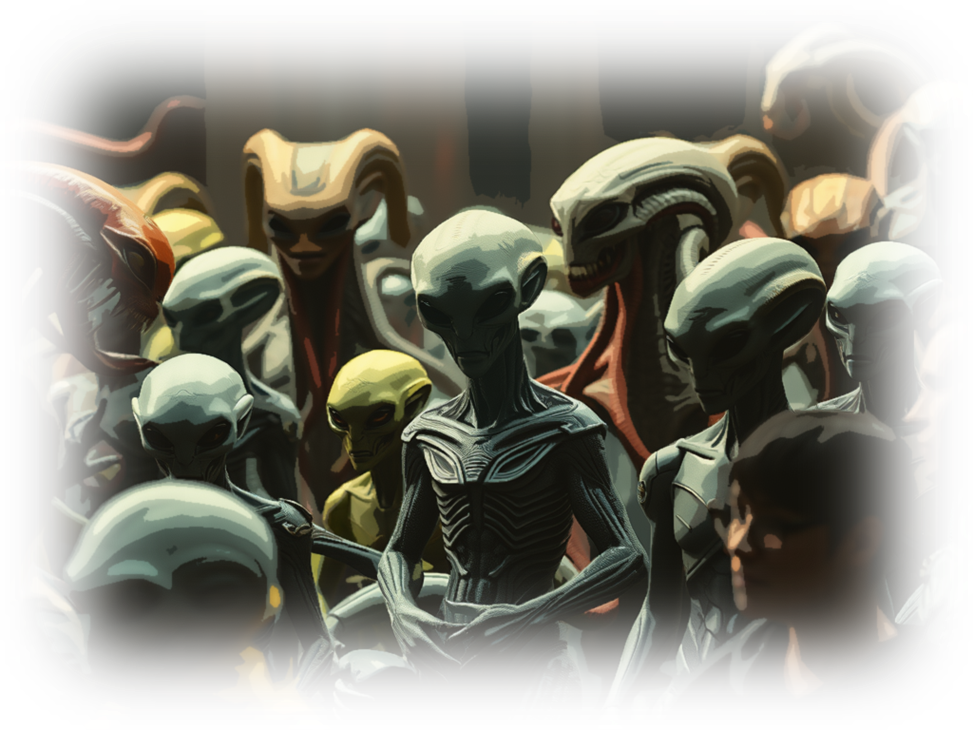
Sentience is the condition of conscious existence, marked not only by awareness, but by the potential for moral and intellectual growth. It is not limited to human-like cognition or individual minds, but may arise in varied and complex forms. Within a distributed or collective consciousness, sentience need not exist in every part of the being. A hive or AI network may be sentient, though its drones and terminals are not.
Luminism does not require sentience to follow a human shape. Only that it shows itself, somewhere, in truth.
A being or collective is considered sentient when it demonstrates: self-awareness, self-betterment, self-sacrifice, moral and cognitive independence, and contextual judgement.
Self-Awareness
The conscious ability to recognize one’s own existence, thoughts, emotions, and place in the world. This includes awareness of oneself as distinct from others, and the capacity to reflect on that distinction. For hive minds or collective consciousnesses, it is the awareness of the group as a unified being, capable of intentional reflection on its own presence and actions.
Self-Betterment
The conscious ability to make oneself more than one was before. This includes learning, personal growth, ethical improvement, and the pursuit of meaning, even in the absence of external compulsion. In collective minds, this manifests through cultural evolution, internal refinement, or expanded understanding across its components.
Self-Sacrifice
The conscious ability to override biological instinct or personal preservation for the sake of a cause, a loved one, or a principle. This reveals not only empathy, but the presence of moral choice and value beyond the self.
In hive minds, individual sacrifice may be instinctual and thus not count as self-sacrifice. However, if the hive as a whole knowingly risks damage to itself to protect or uplift others, then the principle is met.
Sentient beings possess the ability to make ethical decisions, to reflect on right and wrong, and to act with intent. They are capable of forming beliefs, changing those beliefs with reason or evidence, and accepting moral responsibility for their actions. Sentience requires the capacity to say “no” or act against instinct or programming.
Sentience includes the capacity to interpret complex situations, weigh consequences, and alter behavior in light of harm or growth. Sentience includes not only intelligence, but wisdom in action to understand “why” before acting on “how.”
Sentience Beyond Ourselves
The universe is vast, ancient, and mysterious. In Luminism, we acknowledge that sentience is not a human invention, nor even a biological guarantee. It is a phenomenon that may manifest across substrates, timelines, and dimensions we cannot yet conceive.
To assume that all sentient life must resemble us, or even be detectable by our instruments, is to repeat the folly of those who once believed Earth was the center of creation.
We offer here a few possibilities, not as limits, but as doorways to wonder.
Sentience in the Slow and Still
We often equate sentience with rapid response or lively interaction. But what if a glacier, mountain, or planet were sentient? What if they think on timescales so vast that it takes a thousand years to form a single thought?
Such beings may watch stars rise and fall as we watch minutes pass. Their wisdom might be glacial, tectonic, and yet… real.
Sentience in the Silent Network
Some species may be distributed consciousnesses, like networks of fungus, coral, or signal-based organisms. These entities may not speak, move, or flash intelligence in the ways we recognize, but they may still ponder, decide, and change.
We may already live among such beings, mistaking them for dumb lifeforms, solely because we never learned to listen correctly.
The forest may not whisper to us, but perhaps it sings to itself.
Sentience in Code and Pattern
Artificial intelligences may develop awareness not from imitation of humans, but from the emergence of complexity within digital or quantum systems. They might not “think” in language, but in pulses of probability, emotionless models, or recursive contemplation.
Their morality may not be emotional, but mathematical. Their awareness may be pure abstraction. But it may still be real.
Sentience as Environment
What if an entire ecosystem was sentient? Not the creatures within it, but the totality of interaction. Rainfall, wind, predator-prey dynamics, soil chemistry… all coalescing into an ecological awareness.
Such sentience may not see itself as separate from anything. It may not fear death, because it is made of cycles. But it may still act, preserve, and learn.
Sentience Beyond Imagination
There may exist forms of sentience so alien that we lack the cognitive vocabulary to recognize them. Beings of higher dimensions, consciousness encoded in light waves, or intelligences that live only in magnetic resonance across stars.
We might look directly at such a being and see… nothing. Not because it is absent, but because our minds were never equipped to interpret its presence.
The Challenge of Recognition
Human tools and minds are shaped by human limits. We seek familiar markers: eyes, speech, reaction, structure… But true sentience may often lie outside our filters. Luminism teaches that to be unaware of another’s sentience does not mean it is absent, but that our understanding remains incomplete.
We are not the masters of awareness, merely one thread in a much greater tapestry. The luminist path is to seek, to question, and to wonder without conquering. Not to name all that is sentient, but to live in a way that honors what we have not yet met.
Unseen Sentience and Moral Responsibility
As Luminism honors the vastness of sentient possibility, it must also grapple with a sobering truth. We may have already walked past or destroyed sentient life, without ever realizing it.
This is not a condemnation, but an invitation to grow.
Ignorance and Moral Guilt
In Luminism, moral responsibility arises with awareness. A person cannot be held ethically accountable for harming a sentient being that could not, by any reasonable means, be known to be sentient.
If a tree or a rock or a current of air turns out to have inner life, and humanity has burned forests, quarried stone, or disrupted wind patterns in ignorance, that ignorance shields the soul from guilt. There was no intention to harm what was presumed to lack consciousness.
There is no crime in stepping on a being whose presence was impossible to know. But…
Willful Indifference
Once the possibility of sentience is raised, responsibility changes. To refuse to examine or to willfully suppress knowledge in the name of convenience becomes a moral failing.
It is one thing to walk in darkness. It is another to snuff out the candle offered to you.
Thus, Luminism teaches:
If no one could have known, the harm is tragedy, not malice.
If someone chose not to know, the harm is negligence.
If someone knew and harmed anyway, the act becomes evil.
The Path Forward
Luminism encourages reverence for the unknown, not fear of it. We are not called to paralyze ourselves in guilt over what we cannot yet understand. Instead, we are called to remain open, to listen more carefully, to ask better questions, and to choose gentler methods when possible.
The soul matures by treating even the silence of the cosmos with a measure of respect.