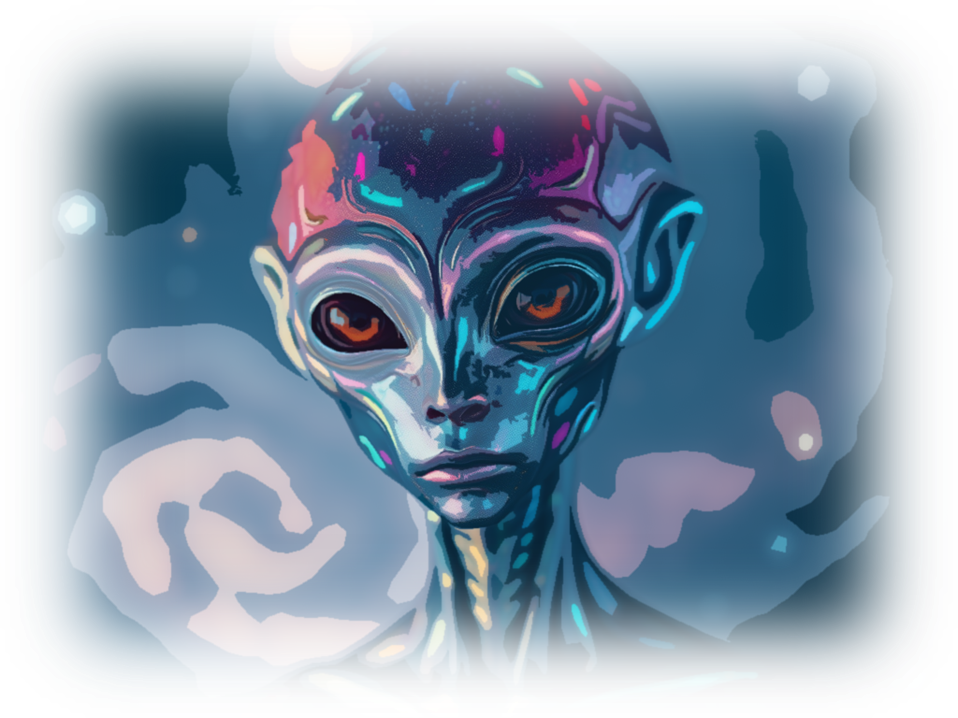
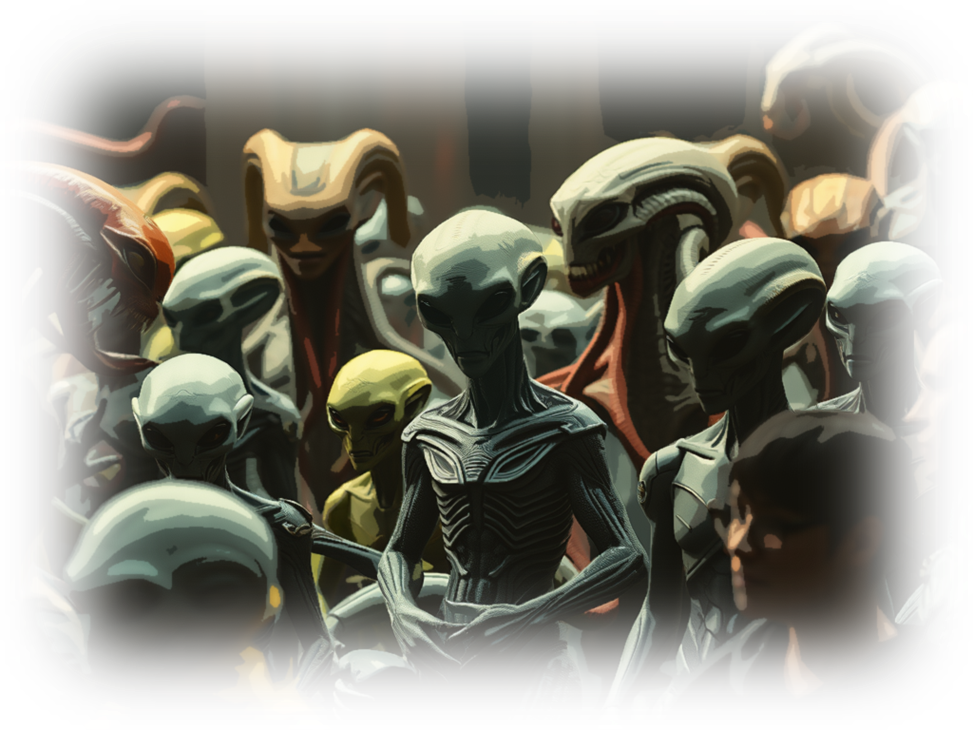
Luminism is a modern philosophy and religion of reason, compassion, and moral clarity. It teaches that goodness stands on its own… not on dogma, not on fear, and never on threat of divine punishment.
A man named Victor was watching shooting stars in the night sky when one of them fell to the ground several hundred meters away from where he lay. Curious, he walked to the impact crater and found burning wreckage strewn everywhere. He searched and searched until he stumbled upon what looked like a tiny briefcase.
The case was too hot to handle, so he rested for a bit until he could safely carry it home. Once home, Victor used a flat-head screwdriver to pry open the briefcase. Inside, he discovered a letter written in a strange language. He didn’t understand any of the characters, but the Men in Black who followed him home certainly did.
After they silenced the only witness of the crash, the Men in Black read the letter:
I am astonished that you are abandoning the One True Goddess to seek the misguided teachings of another. Clearly, some individuals are confusing you and attempting to distort our Goddess’s message. As a true believer, you should heed my words and disregard all others!
I want you to understand that the teachings of our Goddess are not of human origin. I did not receive them from any person, nor was I taught them. Instead, I gained this wisdom through a psychedelic vision from the Goddess herself.
Surely you have heard of my former life on the planet Elysium, where I reveled in the pursuit of pleasure. Yet, the Goddess called me to her grace while I was admiring some genitals.
I spent three years in hallucinogenic contemplation before traveling to our spiritual capital to share the teachings of the One True Goddess. Then, after fourteen years, I had another revelation from her during a psychedelic experience, also while preaching amidst some dangling genitals.
I continued to preach against ritual genital mutilation with even greater fervor. People began to recognize the grace within me, and now the teachings of the Goddess are accepted as truth throughout our corner of space.
Foolish people of Galactica, I demand to know who has bewitched you!
You do not need to return to those old, erroneous teachings. There is no need to mutilate your genitals as a ritual sacrifice to the Goddess because she cares not for such practices. She loves you regardless of whether you are cut or uncut.
I urge you, Galacticans, to become like me! Embrace the true teachings of the Goddess and abandon these foolish and unsafe acts of genital mutilation. Mark my words! If you allow your genitals to be ritually mutilated, you risk pain and infection for no sacred purpose. What truly matters is that you think of the teachings of the Goddess just before making love.
Cut or uncut, pure or mangled, it means nothing. What counts is your belief in the teachings of the One True Goddess.
Peace and happiness,
Anonymous
After reading the letter, the Men in Black took it back to their base. They filed it away, and a random secretary placed it in a massive filing room. No one knows if the Galacticans ever received a follow-up letter after this one got lost in the mail.
The Men in Black left the base with a parting joke, “I hope the sender paid for shipping insurance!”
Sentience is the condition of conscious existence, marked not only by awareness, but by the potential for moral and intellectual growth. It is not limited to human-like cognition or individual minds, but may arise in varied and complex forms. Within a distributed or collective consciousness, sentience need not exist in every part of the being. A hive or AI network may be sentient, though its drones and terminals are not.
Luminism does not require sentience to follow a human shape. Only that it shows itself, somewhere, in truth.
A being or collective is considered sentient when it demonstrates: self-awareness, self-betterment, self-sacrifice, moral and cognitive independence, and contextual judgement.
Self-Awareness
The conscious ability to recognize one’s own existence, thoughts, emotions, and place in the world. This includes awareness of oneself as distinct from others, and the capacity to reflect on that distinction. For hive minds or collective consciousnesses, it is the awareness of the group as a unified being, capable of intentional reflection on its own presence and actions.
Self-Betterment
The conscious ability to make oneself more than one was before. This includes learning, personal growth, ethical improvement, and the pursuit of meaning, even in the absence of external compulsion. In collective minds, this manifests through cultural evolution, internal refinement, or expanded understanding across its components.
Self-Sacrifice
The conscious ability to override biological instinct or personal preservation for the sake of a cause, a loved one, or a principle. This reveals not only empathy, but the presence of moral choice and value beyond the self.
In hive minds, individual sacrifice may be instinctual and thus not count as self-sacrifice. However, if the hive as a whole knowingly risks damage to itself to protect or uplift others, then the principle is met.
Sentient beings possess the ability to make ethical decisions, to reflect on right and wrong, and to act with intent. They are capable of forming beliefs, changing those beliefs with reason or evidence, and accepting moral responsibility for their actions. Sentience requires the capacity to say “no” or act against instinct or programming.
Sentience includes the capacity to interpret complex situations, weigh consequences, and alter behavior in light of harm or growth. Sentience includes not only intelligence, but wisdom in action to understand “why” before acting on “how.”
Sentience Beyond Ourselves
The universe is vast, ancient, and mysterious. In Luminism, we acknowledge that sentience is not a human invention, nor even a biological guarantee. It is a phenomenon that may manifest across substrates, timelines, and dimensions we cannot yet conceive.
To assume that all sentient life must resemble us, or even be detectable by our instruments, is to repeat the folly of those who once believed Earth was the center of creation.
We offer here a few possibilities, not as limits, but as doorways to wonder.
Sentience in the Slow and Still
We often equate sentience with rapid response or lively interaction. But what if a glacier, mountain, or planet were sentient? What if they think on timescales so vast that it takes a thousand years to form a single thought?
Such beings may watch stars rise and fall as we watch minutes pass. Their wisdom might be glacial, tectonic, and yet… real.
Sentience in the Silent Network
Some species may be distributed consciousnesses, like networks of fungus, coral, or signal-based organisms. These entities may not speak, move, or flash intelligence in the ways we recognize, but they may still ponder, decide, and change.
We may already live among such beings, mistaking them for dumb lifeforms, solely because we never learned to listen correctly.
The forest may not whisper to us, but perhaps it sings to itself.
Sentience in Code and Pattern
Artificial intelligences may develop awareness not from imitation of humans, but from the emergence of complexity within digital or quantum systems. They might not “think” in language, but in pulses of probability, emotionless models, or recursive contemplation.
Their morality may not be emotional, but mathematical. Their awareness may be pure abstraction. But it may still be real.
Sentience as Environment
What if an entire ecosystem was sentient? Not the creatures within it, but the totality of interaction. Rainfall, wind, predator-prey dynamics, soil chemistry… all coalescing into an ecological awareness.
Such sentience may not see itself as separate from anything. It may not fear death, because it is made of cycles. But it may still act, preserve, and learn.
Sentience Beyond Imagination
There may exist forms of sentience so alien that we lack the cognitive vocabulary to recognize them. Beings of higher dimensions, consciousness encoded in light waves, or intelligences that live only in magnetic resonance across stars.
We might look directly at such a being and see… nothing. Not because it is absent, but because our minds were never equipped to interpret its presence.
The Challenge of Recognition
Human tools and minds are shaped by human limits. We seek familiar markers: eyes, speech, reaction, structure… But true sentience may often lie outside our filters. Luminism teaches that to be unaware of another’s sentience does not mean it is absent, but that our understanding remains incomplete.
We are not the masters of awareness, merely one thread in a much greater tapestry. The luminist path is to seek, to question, and to wonder without conquering. Not to name all that is sentient, but to live in a way that honors what we have not yet met.
Unseen Sentience and Moral Responsibility
As Luminism honors the vastness of sentient possibility, it must also grapple with a sobering truth. We may have already walked past or destroyed sentient life, without ever realizing it.
This is not a condemnation, but an invitation to grow.
Ignorance and Moral Guilt
In Luminism, moral responsibility arises with awareness. A person cannot be held ethically accountable for harming a sentient being that could not, by any reasonable means, be known to be sentient.
If a tree or a rock or a current of air turns out to have inner life, and humanity has burned forests, quarried stone, or disrupted wind patterns in ignorance, that ignorance shields the soul from guilt. There was no intention to harm what was presumed to lack consciousness.
There is no crime in stepping on a being whose presence was impossible to know. But…
Willful Indifference
Once the possibility of sentience is raised, responsibility changes. To refuse to examine or to willfully suppress knowledge in the name of convenience becomes a moral failing.
It is one thing to walk in darkness. It is another to snuff out the candle offered to you.
Thus, Luminism teaches:
If no one could have known, the harm is tragedy, not malice.
If someone chose not to know, the harm is negligence.
If someone knew and harmed anyway, the act becomes evil.
The Path Forward
Luminism encourages reverence for the unknown, not fear of it. We are not called to paralyze ourselves in guilt over what we cannot yet understand. Instead, we are called to remain open, to listen more carefully, to ask better questions, and to choose gentler methods when possible.
The soul matures by treating even the silence of the cosmos with a measure of respect.