
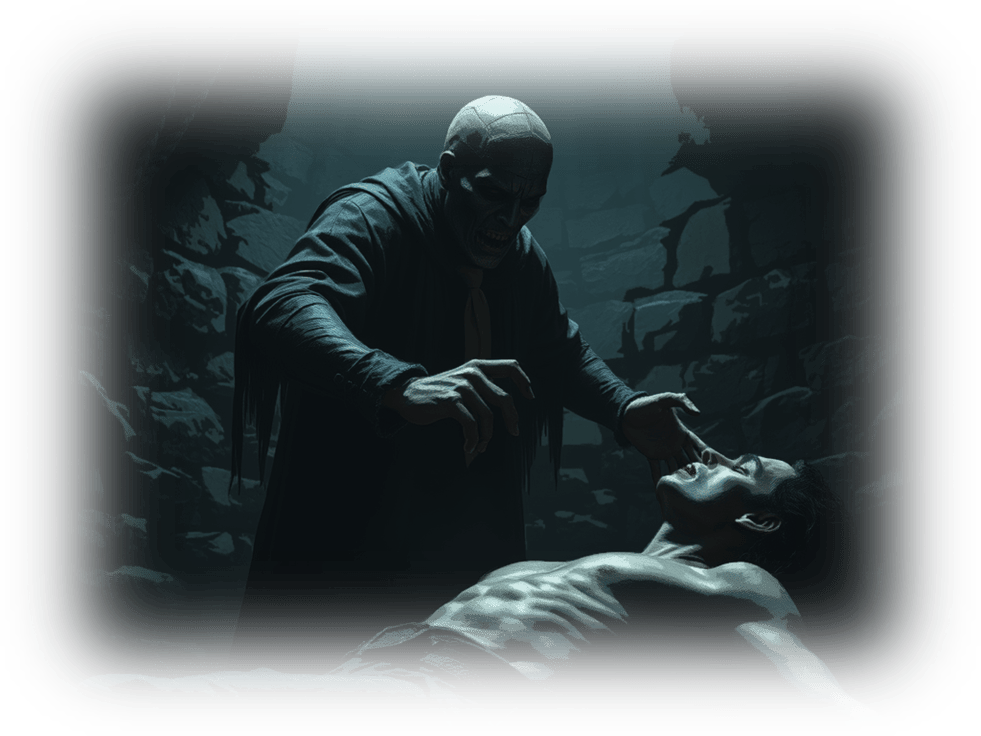
In ages past, one religion gave rise to the Inquisition. It was an organization built not to seek truth, but to punish deviation. People were brought before tribunals and subjected to The Question, a term that sounded noble but concealed cruelty. This was not a question asked in earnest. It was a method of torture designed to extract confessions whether the accused was guilty, innocent, mistaken, or simply inconvenient.
What Was The Question?
The question didn’t matter. What mattered was the answer… and that answer that had already been chosen.
The Inquisition was not a search for understanding, but a ritual of control. The accused were brought in with the expectation of guilt already decided. There was no path to truth, only a path to pain.
To deny wrongdoing was to be deemed defiant.
To confess was to be condemned as guilty.
The Inquisitor
The Inquisitor was not a philosopher, nor a scientist, nor a priest in the noble sense. He was not curious, compassionate, or courageous. He was a loyal servant of the Men In Black, those shadowed figures who labor to crush knowledge and uphold ignorance.
The Inquisitor’s task was simple:
- Suppress truth that contradicted orthodoxy.
- Punish those who asked too many questions.
- Preserve the fragile illusion of absolute authority.
Under the Inquisitor’s gaze, curiosity became a crime and innovation heresy. And truth… became dangerous.
Tactics of Control
The procedures of the Inquisition were designed to create fear, not clarity. The accused were often denied legal counsel, confronted with vague or false accusations, and tortured until they either broke or died. No proof was required, only the suspicion of deviation.
The goal was not confession. It was conformity.
Any new idea, any unapproved knowledge, any alternative viewpoint could be labeled as heresy. And once it was labeled, it could be punished. The Inquisitor wielded the tools of dogma like a weapon, not to test ideas, but to bury them.
Why This Matters
The Not-So Inquisitive Inquisitor is not confined to history. His methods still echo in places where questioning authority is punished, where new ideas are mocked or banned, and where tradition is used as a bludgeon to silence the evolving spirit of humanity.
He can appear anywhere and can assume many forms:
In governments that suppress journalism.
In families that punish difference.
In schools that ban books.
In churches that prioritize obedience over understanding.
Wherever someone says, “Don’t ask that,” or “It has always been this way,” the Inquisitor smiles in the shadows.
The Luminist Response
In Luminism, questioning is sacred, because through it, we grow in knowledge. We reject the Inquisitor’s methods, even when disguised as tradition, piety, or public order.
Let the flame of inquiry burn brighter than the torches of fear.
Let no one be forced to confess to what they do not believe.
Let truth emerge not from coercion, but from curiosity.

