
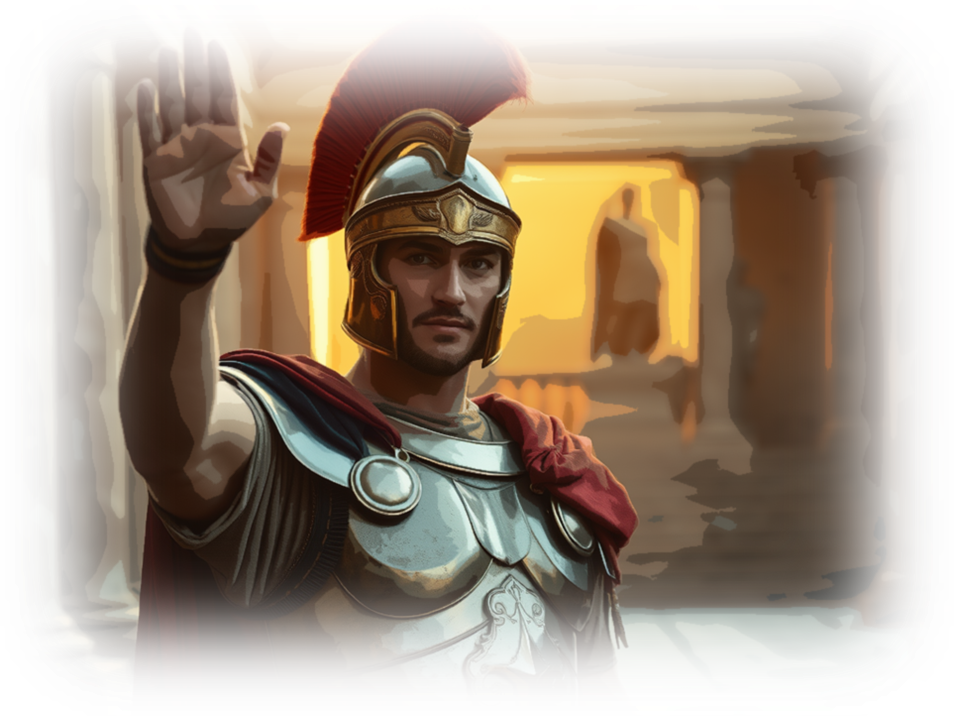
[1]We sailed into a Roman-controlled harbor, and the moment we docked, a soldier approached Jesi. He saluted him with the raised-arm gesture typical of the Romans and addressed him as “My lord,” though there was no reverence in his voice. It struck me that the Romans seemed to worship something greater than their gods. They worshipped the immortal city of Rome itself, and their empire. And yet, Jesi seemed perfectly content with this arrangement. Perhaps with the most powerful political entity in the world, it was obedience that mattered more than worship. Or maybe, they were simply too vast to control.
Or was it that Jesi was just starting out, using us to spread his influence? We were planting the seeds of his miracles in the minds of all who listened, and he would later reap the worship of his adoring followers. Each city we visited was a stepping stone in his plan, each miracle performed a carefully laid piece of his design. One day, when the seeds had taken root, they would blossom into unquestioning devotion. We were only the beginning.
Jesi commanded some men to bring a palanquin for the journey into the city. As we waited, he informed us he intended to preach and heal the sick. The city was several miles inland, and he desired to meditate during the trek. We drew lots to see who would carry him. Four men were chosen, all eager to serve, but Jesi quickly dismissed one. The man was too short, Jesi explained, and would make the ride uneven. He sent the man ahead to announce the arrival of a living god.
Then, with his eyes closed, Jesi raised a hand and randomly pointed in my direction. When he opened his eyes, his finger was aimed squarely at me. But just as my hands instinctively moved toward my ears, his lips curled into a smirk, and his finger circled to the man beside me. “You will do,” Jesi said. His voice boomed in my mind without a single word spoken aloud: I cannot afford to have my chronicler exhausting himself when there are miracles to record.
With Jesi aboard the palanquin, we made our way toward the city. About halfway there, I could hear soft snores coming from within. They continued until the walls of the city loomed ahead. As we passed through the gate, Jesi ordered us to the central square.
A fruit vendor caught his eye, and Jesi handed him a coin in exchange for several apples and a cup of juice. He ate as we moved through the crowded streets, tossing cores to the ground where the beggars and street urchins snatched them up. The cup was discarded too, and it intrigued me. It was thin, lumpy, and oddly shaped, unlike any drinking vessel I had seen before.
When we arrived in the square, Jesi stepped from his palanquin to greet the crowd that had gathered, undoubtedly alerted by the short man he had sent ahead. I briefly wondered where the dwarf was while Jesi stepped toward a platform to speak to the gathered crowd.
There, upon the platform, he declared himself the god Jesi and instructed the people to build a temple in his honor. They were to renounce their gods and worship him alone. The whispers from the crowd were hushed, but noticeable. Jesi’s voice grew louder as he invited the crowd to witness his miracles and asked who among them would be first to receive his blessing.
An old woman approached, trembling on her knees as she begged for relief from her aching bones. The village man accompanying us brought Jesi’s chest of tools, and I watched as Jesi repeated his miracle from the previous day, using the same grey powder. He inserted it into a strange needle and, with a broad smile, warned the woman of a slight pain. She flinched as the needle pierced her, but he promised she would feel renewed by morning. She bowed and scurried off into the crowd.
It was then that I noticed something odd. A group of hooded figures, too neatly arranged compared to the masses. Jesi, too, must have sensed something was amiss. Before I could react, Jesi’s body glowed faintly, and he turned toward the group with fury on his face. He drew his wand-like device, and in an instant, bolts of lightning erupted from its tip. The hooded figures threw off their cloaks to reveal weapons as they charged, but it was too late. The lightning struck them down where they stood, their bodies crumpling to the ground one by one.
A spear flew through the air, aimed perfectly at Jesi. But it merely glanced off the shimmering aura that surrounded him, falling harmlessly to the ground. In mere moments, the square was littered with bodies. Jesi climbed back into his palanquin and ordered us to surround him as we fled the city. His command was clear: “Have faith, and no harm will come to you.”
As we hurried through the streets, a lone guard stepped forward to block our way, but Jesi’s wand flashed again, and the man collapsed before even raising his weapon. We passed through the gate unscathed, arrows fired in our direction bouncing harmlessly off an invisible shield that Jesi had raised. It was not until we had run for nearly a mile that he ordered us to stop and rest.
Jesi pulled out the metallic box he used to conjure food and drink. He distributed liquid among us, filling our cups with a sweet, salty, and faintly alcoholic beverage. He toasted to our coming victory, claiming that we few would lay siege to the city and that its walls would crumble before us. His confidence was unsettling. As I sipped the green liquid, I could feel its effects immediately, refreshing my body but doing little to calm my mind.
Jesi spoke of setting up camp and preparing for the morrow. As I sat by the fire, recording the events in my diary, the weight of the day’s events settled heavily on me. Despite the display of power, the deaths of those men were a stark reminder: no matter how much I despise Jesi, I must never act against him directly. For he may not be a god, but he wields abilities far beyond anything I could ever hope to challenge.
I peeked at Jesi’s transport and saw two eyes peering back from within.
[1] Diary of Miracles (Jesi Saga)
This story is part of a collection of narrative entries, eyewitness records, and sacred illustrations documenting the rise and fall of the false god known as Jesi. This account spans many pages and includes artistic depictions and individual miracle stories recorded by a witness whose voice grows ever more strained under the weight of truth.
This story is part of one continuous chronicle. Treat each section as a chapter within the same diary. Each page is part of a fragmented gospel of a false messiah, exposed through the steady hand of one who dared to witness.
As you read, keep in mind that this is not a story of salvation. It is a cautionary record, and like all cautionary tales, its lesson may arrive only after it’s too late.

